




Training personnel is the training process aims to enhance the knowledge, skills and capacity to work for employees in business. This activity help the adaptation to work, improve performance, developed under the strategic direction of the organization.
One of the core factors that help business is not lagging behind the main source of manpower, but not merely “someone” that is owns a team of capable, innovative thinking, ready to adapt.
However, to get the team as such, the personnel recruitment, good is not enough. Businesses need to have a strategy of “nurture” from the inside through active training personnel basically continuous improvement. As practice shows, many organizations are still misunderstood or taken teen the system when deployed training leads to wasted resources that do not bring the desired effect.
This article Lac Viet SureHCS will help the business better understand training personnel from the definition and roles to how to implement optimal efficiency. At the same time, provides the orientation practical content to build your training practical observation associated with the target employee development and organizational strategy.
1. Training personnel is what? Understand the right to deploy the right
Training personnel (personnel training) is the process of equipping employees with the knowledge, skills and attitude necessary to make good the current job or prepare for positions in the future. This is an active strategic development of internal resources.
Training personnel not only help employees to improve expertise, but also create a sense of interest is investment – a key element helps to increase the level of sticking retain personnel. According to the report LinkedIn Workplace Learning Report 2024, have to 89% hr leader insists that the constant training is the key element in the strategy to retain employees.
A specific example: if a retail business, organization, training of skills, customer care staff not only handle the difficult situation, but also help increase the percentage of customers who return to purchase. I.e., training activities do not stop at the “to know”, but to “create positive change” in the act of work every day.
In summary, training personnel not only is a cost that is investment to bring double benefits: enhance the current productivity, prepare for the long-term development of the organization. And to invest effectively, the first step is to understand properly the concept of the core role of this activity.
2. Why need to plan training hr post?
The organization of training of personnel is not merely an activity internal support which is the key factor affecting the operational efficiency and the ability to long-term growth of the business. Here are the outstanding benefits that a program of training personnel, this special edition is planned training new employees can bring.
2.1. Improve productivity performance work
Training employees to help them master the process of working competently use tools, understand the expectations from the organization. When fully equipped with knowledge and skills required, employees will be more confident in the work from which improve personal productivity contribute more effectively to the entire department.
For example, a new employee in the customer care department when the training lessons on skills to handle the situation and CRM system will shorten the time to solve each request, at the same time increase the level of customer satisfaction. It is of practical value not just stop at the “improved capability”.
2.2. Shorten the duration of adaptation of new employees
No little business to meet employee status new take many weeks, even months to catch up with work. The construction plan, training new employees details that the system will help employees capture fast organizational culture, work processes, tools, support, and core values of the business.
This is also important factors help businesses minimize transition time from which the cost savings keep the string operation is not interrupted.
2.3. Minimize errors in the workflow
One of the common causes lead to errors in the operation is due to the staff “don't know” or “wrong” way of working standard. Content training match, clear examples that will help employees understand right from the beginning, limit the errors affect the quality of products, service or cause legal risks for business.
In particular, for areas such as production, logistics, accounting, it requires the precision, the training periodically also helps updating process, minimize errors repeat control risk more effectively.
2.4. Create a culture of learning in continuous development
An organization know how to invest in people is the organization competitive, sustainable. When the business is not only training new employees but also plan on training personnel long-term, continuously update professional skills, soft skills or knowledge market, a culture of active learning will form.
Employees from it tend to actively learn, improvement suggestions willing to adapt to the change strategy instead of “waiting for direction”. This is one of the factors that help the organization maintain flexibility in the context of the market constantly change.
2.5. Positive impact on the retention of personnel
Not compensation, which is new development opportunities is the leading factor that employee long-term commitment. A program of training employees effectively shown that businesses interested in the growth of the profession of the individual. Employees feel valuable development roadmap is clear.
This is a proven fact: the business has a policy of training and development hr best often have resting rate, the lower the cost savings recruit, retain resources experienced.
3. The form of training personnel currently popular
In the strategy development team, choosing the right form of training in accordance with organizational capacity and the actual needs of employees are important factors to ensure efficiency. Each form of training personnel has advantages – and disadvantages, can meet different objectives in planning the training of new employees or raise the overall capacity. Here are the three most common forms today.
3.1. Training internal (In-house training)
Training internal is a form of training by the business organization with resources teaching is the management, professional, experienced, or personnel in charge of deployment.
Outstanding advantages:
- Customization: Business easily design content training with actual business, industry or internal processes.
- Optimal cost: No cost hire external trainers or held classes at the center.
- Increase internal connection: the process of internal training to help the department understand each other better, from that increase coordination in the work.
For example: A manufacturing enterprise can organize the training of internal processes, quality control, product, or rules of labor safety at the factory, in accordance with the characteristics operate on their own.
Restrictions should be noted:
- The quality of the training depends on the level of pedagogy and the ability to convey of the front of the classroom. Not everyone has the expertise, skilled can also teach effectively.
- The update is the new trend exterior can be limited if only internal training.
To maximize the benefit of this form, the business should build plan training personnel-specific competencies and fostering skills training for teaching staff internally.
3.2. Training outside (External training)
External training is the business to hire the expert, organization, or center professional training for teaching staff.
When should I choose?
- When the need to update knowledge, new in-depth about a specific field, such as digital marketing, project management, Agile or legal personnel.
- When the organization is not enough resources and expertise to build the training program.
Actual value the business receives:
- Access to knowledge benchmark bring updates: This is the big advantage to help businesses improve the quality of resources quickly.
- Motivational professional learning: Work is learning with expert credibility or at the base of modern training often inspiring motivation to study for employees.
However, the cost of this form are often high and difficult to control content if there is no coordination from the business side. Therefore, enterprises should integrate this form into the plans, training personnel has the focus, instead of implementing a seamless experience to save resources.
3.3. Online training – flexible solutions in the digital age
Online training (online training) has become a popular choice in the context switch number. With the support from platforms such as Vietnam eLearning, businesses can easily deploy the program for training personnel on a large scale that still ensure efficiency.
Outstanding advantages:
- Flexibility in time and place: Staff can learn in his spare time, do not interrupt the main work.
- Cost savings: No need to rent locations, faculty, or printing documents.
- Easily track, measure: training Management can track progress, learning outcomes through system LMS (Learning Management System).
For example: When onboard new employees, businesses can use eLearning course on corporate culture, internal processes or soft skills instead of class organization directly – saves time of both the learner and the instructor.
Note when applying:
- Need to invest thoroughly in content training: forms online only effective when the content is designed easy to understand, interact well, there's practical value.
- Combine flexible with live training to ensure both acquisition theory, just be practice.
4. The step by step build program training personnel efficiency
To build a program of training personnel really bring value to the business, need to follow a clear process keep abreast of the target resource development. Here are four important steps, from identifying needs, to measure the effectiveness help business development program training new employees correctly, cost savings and optimal performance.
4.1. Needs analysis, training, practice
Before planning training personnel, businesses need to start from the answer to the question: “Employees are what's missing? The skills and knowledge that will help them work more efficiently?”. Determining training needs should be based on the specific data such as:
- Performance reviews periodically: The location results do not reach the expectations is the signal for a need to have assistance in terms of capacity.
- Feedback from direct management: They are best understood the shortage of skill or expertise of the team.
- Changes in business strategy or technology: When business navigation developer or app new system, the training is mandatory in order to team up to adapt.
For example: A business implement new ERP software need to quickly organize training for staff accounting, sales and inventory management to ensure the operation process is not interrupted.
4.2. Identify specific goals for the program
The goal is to help businesses measure the effectiveness of the entire program training. To ensure clear – viable, let's build target according to the model SMART – specific (Specific), measurable (Measurable), attainable (Achievable), realistic (Realistic), there are time limits (Time-bound).
For example:
- The target has not yet effective: “soft skill Training for sales staff.”
- Goals more effectively: “Within 4 weeks, 100% of employees business master skills to handle clients refuse, expressed through the completion of the test, reaching a minimum of 80 points.”
How to identify a target so clear, not only helps team training design the right content, which also helps leaders easily evaluate the level of success of the program.
4.3. Content design training with practical work
This is an important decision program training new employees or existing there really useful or not. Content training should focus on the skills and knowledge that employees can apply directly to daily work.
Principles of effective design:
- Not theory alone: Avoid courses only focus on definitions, concepts. Instead, put into real-life situations, exercises, simulation or case study of business.
- Differentiation according to group objects: new Employees should be trained about the corporate culture, the basic process. Meanwhile, the management team needs to focus on leadership skills, decision making.
- Integrate diverse methods: combination of live training, online learning, video tutorials, test... help increase receptive maintain interest in learning.
For example: In the program onboarding, content, training can include video introduction of departments, the course of the approval process, interactive questionnaire about the conduct internal.
4.4. Deploy measurement results
A program of training personnel efficiency does not stop at the completion of the course, which must be measurable change in thinking, skills and work performance. Businesses can apply the following methods to evaluate the results:
- Test after training: Help measure the level of acquisition of knowledge.
- Feedback from learners and management: through survey or interview fast.
- Index of job performance (KPI): tracking changes in the rate of completion of the work, the quality of output after training.
If a training program does not bring positive change, businesses need to review from the stage of identifying needs, goals, up until the deployed content.
5. Ứng dụng phần mềm Lạc Việt Elearning vào quản lý hoạt động training nhân sự
In the context of transformation of today, the application of technology in governance, personnel training, not only is the trend that has become an essential component to optimal performance. Especially with the enterprise-scale personnel, the management plan training craft easily lead to overload, errors, lack of transparency.
Benefits of using management software training
- Process automation: From the construction of route training, content distribution, class organization to track progress, everything is done for a system.
- Update easy measurements: software helps to manage the entire learning history, assessment results and complete levels in each individual.
- Optimal resources: Discount depends on the administrative team, increase the autonomy of transparency for both learners and managers.
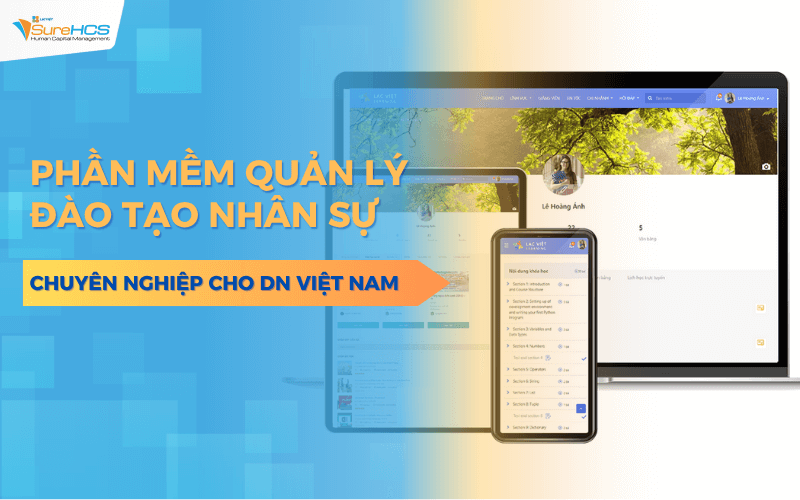
Vietnam e Learning is the foundation internal training is developed in accordance with the needs of business English. With friendly interface, rich features, and its ability to integrate easily with other systems, software, helps enterprises:
- Design content training specialized for each group of personnel.
- Automate the process of organizing training for new employees.
- Provide detailed reports to help managers evaluate the effectiveness each course according to each particular index.
LAC VIET E-LEARNING – SOLUTIONS, PERSONNEL TRAINING, INTERNAL BUSINESS PERFORMANCE MEASUREMENT
Lac Viet E-learning is the trusted choice of many large corporations such as FrieslandCampina, PV GAS, Shinhan Bank... with more than 100,000 users across the system.
LV E-Learning is not just a training system online, which is the platform that helps businesses build human capacity in a sustainable way. The solution is designed to solve the fulness of the problem: training – measurement – develop – retain talent in the work environment is great.
- Difference of LV E-Learning lies in the ability to combine flexibility between technology, learning experience and management training. Businesses can deploy according to the SaaS model or on-premise, easy to integrate with existing systems
- In compliance with the international standards such as SCORM, OpenBadges, ensuring standardized and scalable long term.
- Don't stop at the “bringing material up system,” LV E-Learning create learning environments multimodal: online class, learning materials, multimedia, forum for exchange of knowledge, exam – assessment – certificate automatically.
- The entire learning process of the employees are tracking, analysis, reporting in real time, to help businesses accurately assess the effectiveness of training and the level of capacity development.
- Modern interface, high security, automation, deep, ability to analyze training data to help businesses optimize the cost of training, improve work productivity, increase employee engagement.
SEE DETAILS MANAGEMENT FEATURES TRAINING LV E-LEARNING AT HERE
Ready to elevate effective internal training in your business?  Contact us Lac Viet today for advice model implementing E-Learning in accordance with the scale, industry and development goals of the business.
With version Cloud, LV E-learning can deploy fast in 7 daysno need to invest in infrastructure, high security and are willing to expand to tens of thousands of users.
SIGN UP TO RECEIVE DEMO NOW
CONTACT INFORMATION:
- Hotline: 0901 555 063
- Email: [email protected] | Website: https://www.surehcs.com/
- Office address: 23 Nguyen Thi Huynh, Phu Nhuan, ho chi minh CITY.CITY
The application software Lac e Learning into operation training doesn't just stop at the convenience. Things that business get is:
- Cost savings: Reduce printing costs, hire trainers, held traditional classroom.
- Save time: shorten the preparation time and track the learning process.
- Increase management effectiveness: an overview and transparency about the route capacity development of each employee.
Software Lac e Learning not only enables the organization and management program for training personnel in an efficient manner that also provides complete tools to construction business development roadmap comprehensive capacity from onboarding new employees to enhance the professional skills and development team design approach. With friendly interface, full features, the ability to customize according to each business model, Lac Viet eLearning help transform operations training from craft to professional, quickly effective.
If your business is looking for a tool to optimize the operation training staff, let's start exploring the platform Lac Viet eLearning – training solution internal, flexible, effective, and suitable for all models business English. Contact now to get advice and experience for free.