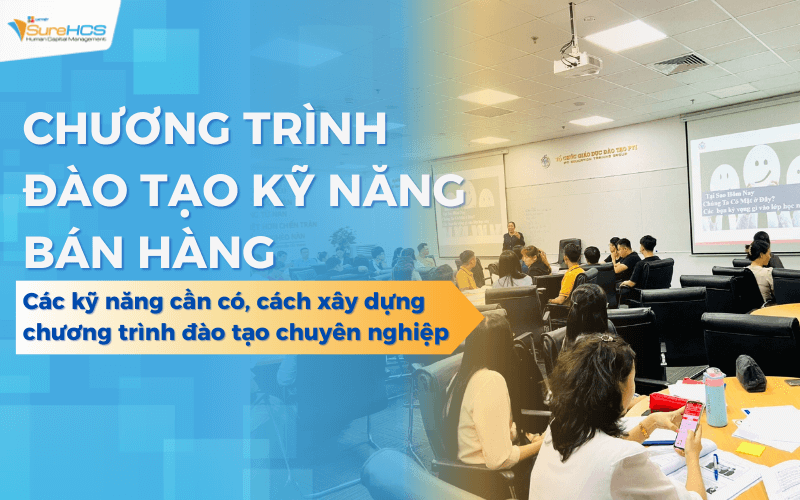






Training, communication skills, customer is the program that helps the sales staff, customer care, consulting services, to improve the ability to exchange information, listen to and handle situations with customers. Once trained, employees can build trust, understanding needs, thereby improving the customer experience throughout the sales process.
For business in the service sector, particularly insurance, finance, retail,... the investment in training, communication skills, customer help:
- Increase the rate of key contract
- Reduce the percentage of customers who leave
- Build brand image professional
The article below Lac Viet SureHCS will help businesses understand the benefits, training content and methods of implementing effective training programs, communication skills, customer.
1. Skills training, customer communication is what?
Training, communication skills, customer is the process of training, capacity development for staff to help them interact effectively with customers through words, body language, attitude to serve and how to handle situations in the sales process or customer care. This is an important content in the training program's internal business, particularly in the service sector, financial, insurance, retail, and real estate.
In fact, communicating with customers is not merely the exchange of information. A staff having good communication skills need to know listen to the real needs of customers, to express information clearly and to create the trust and sympathy throughout the process of interaction.
The goal of the training program, communication skills, customer, usually focusing on the core competencies below:
- Understand the psychology, behavior of customers in each situation
- Convey clear information, easy to understand, persuade
- Build sympathy and trust with customers
- Handle questions or complaints in a professional manner
- Maintain long-term relationships with customers
For example in the insurance industry, when customers find out about a package, health insurance, what they are interested in not only the charge level but also the level of financial security for family in the future. If the employee only focus on introducing products that do not listen to the concerns of customers, the exchange is very difficult to achieve efficient. Conversely, when counselors know ask questions and listen carefully, they may propose solutions more suited, thereby increasing the ability of customers to sign a contract.
2. Benefits of training, communication skills, client for business
In many service industries such as insurance, finance, retail or real estate, clients often contact with staff before decide to buy products. So, the quality of communication between staff and the customer can directly affect sales and brand image, the level of customer loyalty.
Training programs, communication skills, customer help enterprises standardize the way employees interact with the customers, which brings many practical benefits in business operations.
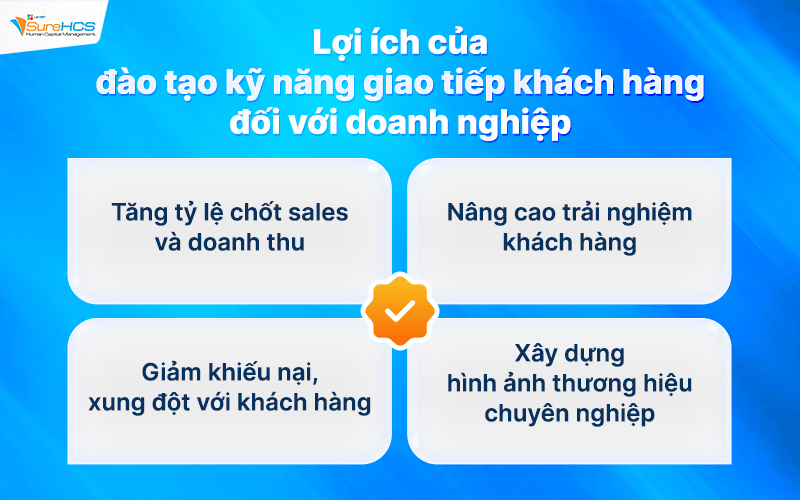
2.1 Increase the rate of key sales and revenue
One of the most obvious benefits of the training to communicate customers is to help sales staff to understand customers better and consulting the right needs more.
In fact, many transactions fail not because the product is not good, but because employees don't understand the problems our customers are interested in, or present information not yet clear. Once trained, employees will know how to:
- Listen to understand the real needs of customers
- Asking the right questions focus to information extraction
- Presented solutions tailored to each customer
For example in the insurance industry, many customers often worry about the contract terms, or insurance benefits. If the counselor only read product information mechanically, the customer will feel difficult to understand and lack of trust. However, when employees are given training, communication skills, customer, they will know how to interpret rights in plain language and give practical examples to help customers easily understand to make a decision.
For business, this not only helps to increase the rate of signing the contract but also improve the efficiency of the entire sales team.
2.2 enhance customer experience
Today, customers are not only interested in the product but also pays great attention to experience when interacting with the business. An exchange of friendly, clear and respected customers can create a positive impression long.
This shows the experience communicating with employees is an important factor in retaining customers. When business development training program effective communication, employees will be able to:
- Feedback quickly the needs of our customers
- Explain information clearly, easy to understand
- Feeling respected listen
For example in the insurance industry, when customers call in to ask about benefits, compensation, by feedback of personnel decisions will be perceived by the customers of the business. If the employee a clear answer, patiently explained, step by step instructions, customers will feel reassured a lot more.
In the long run, a positive experience will help businesses increase the percentage of customers who come back and raise the level of loyalty with the brand.
2.3 Reduce complaints, conflicts with customers
More business for that customer complaints mainly comes from the quality of the product. However, in reality, no less the case complaints happen due to the way employees communicate or handle the situation is not appropriate.
A staff lack of communication skills can:
- Reply customer lack of clarity
- Emotional response when you meet difficult customers
- Don't know how to explain or guide the client
Training programs, communication skills, customer help staff develop the key competencies such as:
- Emotional control in stressful situations
- Listen to understand customer problems
- Explain the information in a calm transparent
2.4 build brand image professional
Each employee when in contact with customers are the people who represent the image of the business. The way they talk, feedback, and problem solving will directly affect how customers perceive the brand.
When business development training program to communicate basically, the entire staff will have-way communication unified and more professional. This helps businesses:
- Make a good impression right from the first contact with customers
- Enhance credibility reliability of the brand
- Increase the ability of customers to recommend business for others
For businesses in the service sector such as insurance, where the trust of customers plays an important role, investing in training, communication skills, customer not only helps to improve sales effectiveness but also contribute to building sustainable brands in the long term.
3. The important skills in training customer communication
A training program effective communication not only in theory that should focus on developing the practical skills to help staff applications right on the job. Below are the core skills are often put into training programs, communication skills, customer in many businesses.
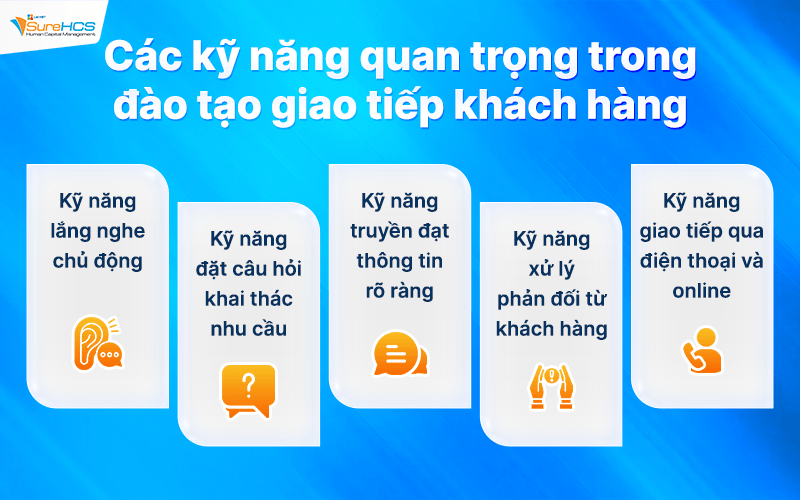
3.1 Skill active listening
Active listening is the ability to focus entirely on the content customers are sharing, instead of just waiting for their turn to say. This is one of the most important skills in customer communication.
Employees have listening skills are:
- Do not interrupt when customers are present
- Focus on important information customers share
- Ask questions to understand the problem better
For example in the insurance industry, when customers share that they worry about medical costs when older employees need to listen and learn more about the family circumstances of the customer. From there, the counselor can suggest package of health insurance, matching instead of introducing many products are not related.
3.2 questioning Skills mining needs
Asking the right questions a way to help staff understand the needs, desires and concerns of our customers. This step is important to help the consultants become more efficient.
In training, client communication, employees are instructed to use the question type as:
- Open-ended questions to encourage customers to share more information
- Questions verified to ensure properly understand customer needs
- Guiding questions help the client weigh the right solution
For example, instead of asking a general way as “He/she want to join insurance't you?” employees can ask:
“He/she is interested in health protection for the family or accumulated financial future?”
Such questions help the exchange becomes more natural, and helps employees understand the needs of customers.
3.3 Skills to convey information clearly
In many service industries, especially the insurance or financial information products are often quite complex. If the employee presented too many professional terminology, customer can feel confusing cause loss of interest.
Therefore, an important skill in training customer communication is conveying simple information easy to understand. Staff needed:
- Using language closer to customers
- Present the information in a step by step clearly
- Illustrated by practical examples
For example when explaining insurance benefits, employees can take out specific situations to customers easily visualize instead of just reading the contract terms.
3.4 handling Skills objections from customers
In the process of consulting or sales, customers often have concerns or objections related to:
- Product cost
- Contract terms
- Time commitment
If the employee does not know how to handle these objections, the exchange very easy to end without achieving the desired result.
Through training programs, communication skills, customer, employees will learn how to:
- Calm, listen to the opinion of the customers
- Learn the real cause of opposition
- Explain product benefits in a reasonable manner
When handled properly, many objections of customers can become opportunities for staff to explain more about the value of the product.
3.5 communication Skills via phone and online
In the digital age, communicating with customers, not only directly but also through many other channels such as phone, email or the online chatting platforms.
Especially with the team of telesales or customer care, communication skills over the phone plays a very important role. Employees need to know how to:
- Introduction brief information clear
- Keep friendly voice professional
- Guide customers to specific when need support
A training program effective communication will help staff proficient in many forms of communication, ranging from direct access to communicate over the channel online. This helps businesses improve the quality of service and better meet the needs of customers in the environment of modern business.
4. Program content, training, communication skills, customer
A training program, communication skills, effective customer focus not only on theory but need to build training content with the fact the work of employees. Especially in the service industries such as insurance, finance, retail or real estate, staff, regular contact with customers in many different situations. Therefore, training programs should help employees understand customer psychology, know how to communicate professionally and handle the situations that arise in a flexible way.
Here is the important content is usually put into the training program at the business.
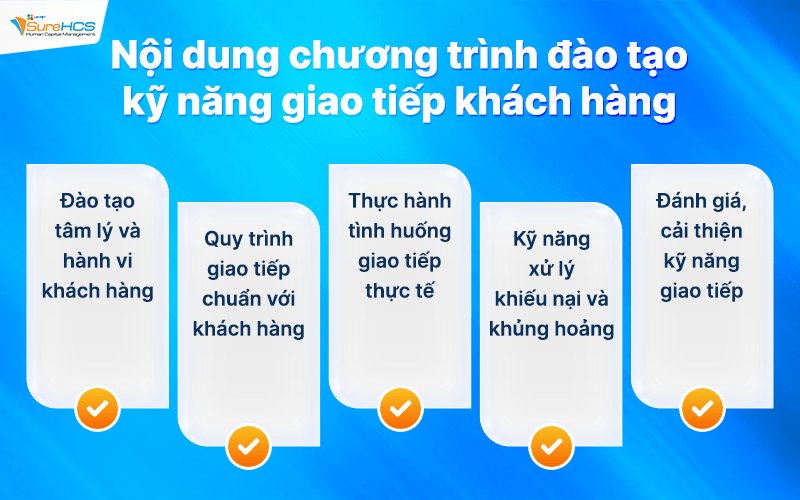
4.1 psychological Training and customer behavior
Understand customer psychology is the foundation of all communication activities. When employees understand customers are thinking, anxious something, want something, they will easily take out the appropriate way to communicate over.
In content this training, employees are instructed to identify a number of psychological characteristics common of the client as:
- Customers seek safety trust before a decision
- Customers often compare multiple options before buying the product
- Customers easily influenced by experiences and emotions in the communication process
This suggests that if employees focus only presents information products without regard to the feelings, needs of customers, the ability to persuade will decrease significantly.
For example in the insurance industry, many customers are interested in financial protection for the family rather than the specifications of the contract. When we understand this mentality, employees can adjust the communication way according to the guide explain the actual benefits of the product instead of just presenting terms.
Putting content customer psychology into training programs, communication skills, customer help staff build approach customers more effectively and create the trust in the counseling process.
4.2 process standard communication with customers
Besides understanding the psyche customers, businesses also need to build a process communication system to ensure the quality of service on the entire system.
In the training program, employees are often guided a process to communicate basic steps such as:
- Step 1: say Hello to creating a first impression. Employees need to introduce yourself clearly, show a friendly attitude, respect for customers.
- Step 2: understand customer needs. Through the matching questions, employees can understand the desired goals of the client.
- Step 3: advise the right solution. Based on the information collected, the staff put out your products or services fit the needs of the customer.
- Step 4: answer questions, handle objections. Customers usually have many questions or fret before making a decision. Staff should explain clearly transparent.
- Step 5: finish the exchange and maintain contact. After consultation, the staff should thank the customer, maintaining contact to build lasting relationships.
The standardization process communication helps businesses ensure that whether our customers work with employees, they still get to experience consistent service professional.
4.3 practice situations real-life communication
A common mistake in training is focused only on the theory that lack of practice. Meanwhile, communication skills, can only improve through practice and practical experience.
So, in the training program, communication skills, customer, business casual construction simulator situations to practice staff.
For example a number of situations often be put into training:
- Customers are comparing many different products
- Clients worry about the cost or the contract terms
- Customer has to trust the product
- Customers want to be more detailed explanation
Through the practice sessions this, employees have the opportunity to:
- Apply knowledge learned to real world situations
- Training how to handle objections of customers
- Get feedback from faculty members or management
How this training helps employees be more confident when communicating with customers in real work.
4.4 Skills complaint handling and crisis
In business process arising complaints from customers is unavoidable. The important thing is not to completely avoid complaints, which is the way businesses handle that problem how.
If staff are trained in communication skills, handle complaints, many stressful situations can be solved quickly and even helped to improve relationships with customers.
In content this training, employees are often guided principles such as:
- Listen to the customer in a calm manner
- Show empathy, respect
- Clearly explain the cause of the problem
- Given the settlement reasonable
For example, when the client reflect on the wrong insurance benefits, employees need patience to explain information and instructions for the next step rather than argue with the customer.
These skills help businesses reduce the risks of losing customers, maintaining brand reputation.
4.5 evaluate, improve communication skills,
A training program is only really effective when the business has methods to assess and improve the skills of employees after training.
A number of evaluation methods are often applied include:
- Test your knowledge after the course
- Observe the actual process of communicating with customers
- Collect feedback from customers
- Evaluate the effectiveness of sales staff
Through the assessment activities in this business can identify the strengths, point to the improvement of employees, from there continue to complete the training program, communication skills, customer in future.
5. The training methods, communication skills, effective customer
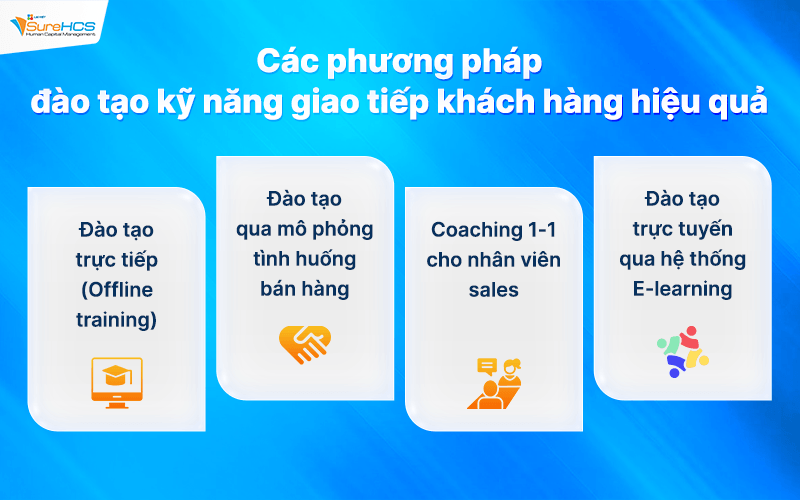
To the training program effectively, businesses need to choose the method of training in accordance with the scale of the organization, job characteristics and the capacity of staff. Today, many enterprises combine multiple methods of different training to optimize learning efficiency.
5.1 live Training (Offline training)
Direct training is the traditional form in which the lecturer or specialist training will guide staff in the classroom.
Advantages of this method are:
- Direct interaction between faculty and students
- Easily answer questions in class
- In accordance with the practice sessions or group discussions
However, with the more business branch or large staff, live training usually more costly organization, time.
5.2 Training through simulation situation, sales
This method of training focuses on practice. Staff will be involved in the situation simulates the same with the real work, such as:
- Advise customers first
- Explain product benefits
- Handle objections from customers
Through this method, employees not only understand the theory, but also hone your skills to handle the situation. This is an important content in many training programs, communication skills, customer today.
5.3 Coaching 1-1 for sales staff
Coaching 1-1 is a form of training directly between management and employees. In this process, management will:
- Observe how employees communicate with customers
- Analysis of strengths, point to improve
- Give specific instructions to employees to improve skills
This method is especially effective with the sales team, or insurance advice, because each employee has communication style and different strengths.
5.4 online Training through E-learning system
In recent years, many businesses have started applying technology to personnel training through E-learning system.
This form of training allows business:
- Training synchronization for multiple branches
- Cost savings class organization
- Allow employees flexible learning in his time
- Track learning progress, the results of training of each employee
For businesses with sales team east or operate in many different areas, the combination of live training with E-learning system, help in training programs, communication skills, customer is implementing effective sustainable over the long term.
6. Deployment process training programs, customer communication for business
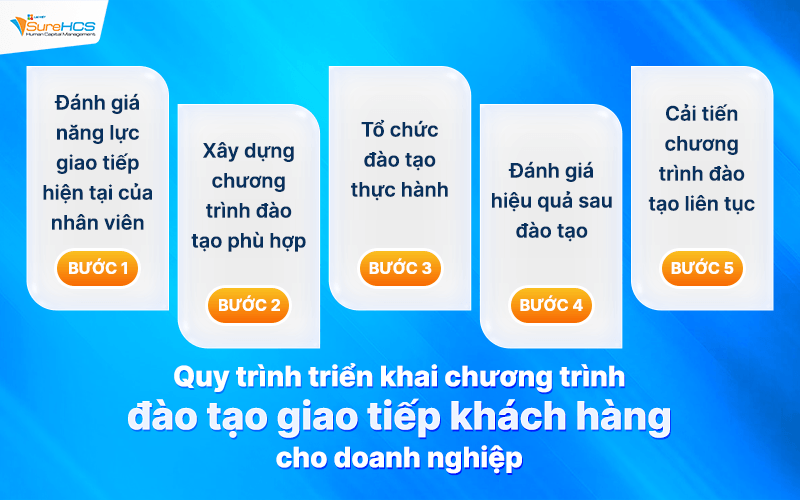
To program training, communication skills, customer bring really effective, businesses need to deploy to a process that basically instead of just holding the course discrete. A clear process to help businesses identify the right training needs, design appropriate content, and measure the effectiveness after implementation.
Here are the important steps in training process that many organizations apply.
Step 1: Assessment of communication skills of current employees
Before the construction of the training program, businesses need to understand the communication skills of current staff. If there is no step this review, this training program is very easy to fall into a state of content does not fit or does not properly solve practical problems.
Businesses can assess the communication skills of the employees through a number of methods such as:
- Direct observation process staff to communicate with customers
- Survey satisfaction level of customers
- Analysis of feedback or complaints from customers
- Reviews of the management directly
For example in the insurance industry, businesses can record the advice of staff or follow up feedback from customers after the counseling session. Through which managers can recognize the common problems such as staff explain unclear, unknown mining needs or handle objections, yet effective.
When clearly understand the current capability of the employees, businesses will have the basis to build the program proper training and avoid wasting resources.
Step 2: build your training program accordingly
After identifying the training needs, the next step is to build the training program, communication skills, customer in accordance with the characteristics of the business.
A training program effective often need to answer the following questions:
- Employees need to improve communication skills, how?
- The communication situation which often occurs in the work?
- Form of training that complies with the staff?
For example, for a team of insurance consultants, training programs can focus on the content as:
- Questioning skills to understand customer needs
- How to interpret rights in the contract easy to understand
- Method of handling objections of customers
Meanwhile, for our team of customer care training programs can focus more on skills to handle complaints and resolve problems.
The design of training programs based on specific work help employees easily apply knowledge into practice, thereby improving the effectiveness of training.
Step 3: Organization, training, practice
After the construction of the training content, businesses need to organize training activities and practice for employees.
A training program effectiveness are often combined in many different forms such as:
- Training directly at the classroom
- Group discussion and share practical experience
- Simulation situations to communicate with customers
- Online training through E-learning system
In it, the practice plays a very important role. When employees are involved in the situation simulation like real work, they will be easy to memorize knowledge and more confidence when communicating with customers.
For example, in the training program for sales staff, insurance, instructors can build situations such as:
- The customer has confidence in the product
- Customers concerned about the cost of insurance
- Customers want to compare many products
By practicing these situations, employees will learn skills to handle objections and raise the possibility of consulting.
Step 4: evaluate the effectiveness after training
A common mistake of many businesses is training organization, but does not measure efficiency after finishing the course. This makes business difficult to determine whether the training program can bring real value or not.
To evaluate the effectiveness of training programs, communication skills, customer, businesses can use a number of indicators such as:
- The level of customer satisfaction
- Rate pegs sales of sales team
- Number of customer complaints
- The survey results after training
According to the model training assessment of Donald Kirkpatrick – one of the popular models in management training – effective training should be evaluated in many different levels as the feedback of students, the level of acquisition of knowledge, impact on business results.
The effective measurement to help businesses understand the training program has brought what value should adjust what content in the future.
Step 5: program Improvement continuous training
Needs, behavior of customers always change over time. So, training programs, communication skills, customer also need to be updated and improved regularly.
Business should periodically:
- Collect feedback from employees after the training course
- Analysis of the feedback from our customers
- Update training content according to the market trends
For example, before communicating with customers mainly takes place directly. However, today many businesses to interact with customers through various channels online, such as email, social media or chatbot. This requires training programs to add content about communication skills through the digital platforms.
Continuous improvement helps training program is always consistent with business practice and bring long-term value for the business.
7. Upgrade the program for training personnel with LV E-Learning
In the context of business have increasingly focused capacity development team, organizing training programs, communication skills, customer or professional training internal commonly encountered challenges, such as difficult to manage academic progress, difficult to assess training effectiveness and cost much class organization. To solve these problems, many businesses have started the application platform online training aims to digitize the entire training procedures for personnel.
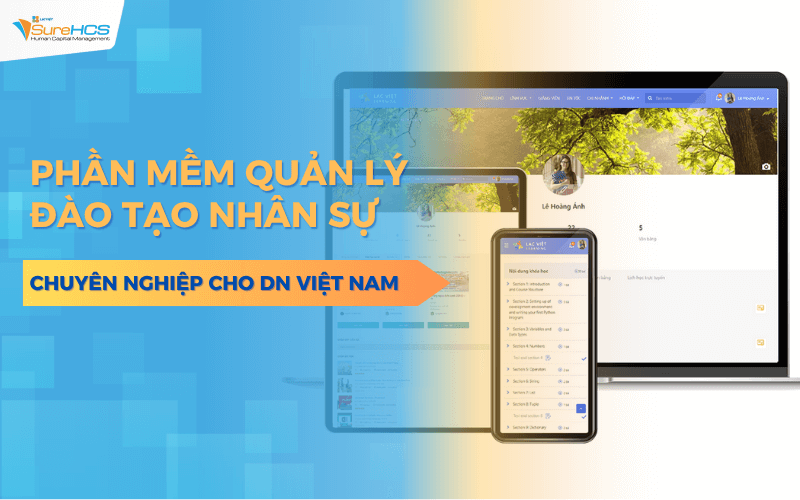
Management software training LV E-Learning is a solution for training personnel is built according to the model LMS (Learning Management System – learning management). Learn simple, LMS is a platform that allows businesses to create courses, manage trainees, track learning progress and evaluate training effectiveness on a centralized system. Thanks to that, the entire operation internal training from construction program, deploy training to assess the results are more easily managed.
With the ongoing business training programs, communication skills, customer, sales training, or training for new employees, LV E-Learning brings many practical benefits such as:
- Standardized training content for the entire branch system
- Help employees flexible learning anytime, anywhere
- Monitoring and evaluation training effectiveness in a transparent way
- Optimal cost training organization in the long term
LAC VIET E-LEARNING – SOLUTIONS, PERSONNEL TRAINING, INTERNAL BUSINESS PERFORMANCE MEASUREMENT
Lac Viet E-learning is the trusted choice of many large corporations such as FrieslandCampina, PV GAS, Shinhan Bank... with more than 100,000 users across the system.
LV E-Learning is not just a training system online, which is the platform that helps businesses build human capacity in a sustainable way. The solution is designed to solve the fulness of the problem: training – measurement – develop – retain talent in the work environment is great.
- Difference of LV E-Learning lies in the ability to combine flexibility between technology, learning experience and management training. Businesses can deploy according to the SaaS model or on-premise, easy to integrate with existing systems
- In compliance with the international standards such as SCORM, OpenBadges, ensuring standardized and scalable long term.
- Don't stop at the “bringing material up system,” LV E-Learning create learning environments multimodal: online class, learning materials, multimedia, forum for exchange of knowledge, exam – assessment – certificate automatically.
- The entire learning process of the employees are tracking, analysis, reporting in real time, to help businesses accurately assess the effectiveness of training and the level of capacity development.
- Modern interface, high security, automation, deep, ability to analyze training data to help businesses optimize the cost of training, improve work productivity, increase employee engagement.
SEE DETAILS MANAGEMENT FEATURES TRAINING LV E-LEARNING AT HERE
Ready to elevate effective internal training in your business?  Contact us Lac Viet today for advice model implementing E-Learning in accordance with the scale, industry and development goals of the business.
With version Cloud, LV E-learning can deploy fast in 7 daysno need to invest in infrastructure, high security and are willing to expand to tens of thousands of users.
SIGN UP TO RECEIVE DEMO NOW
CONTACT INFORMATION:
- Hotline: 0901 555 063
- Email: [email protected] | Website: https://www.surehcs.com/
- Office address: 23 Nguyen Thi Huynh, Phu Nhuan, ho chi minh CITY.CITY
Thanks to that, the enterprise does not only improve the quality of training but also built a culture of learning, continuous help staff capacity development and better adaptation to the change of market.