




In the past several years, training the internal is still one of the most important but also expensive, most complicated for the business. Model train traditional – class organization, hire trainers, printed material, usually high cost, difficult to evaluate the effectiveness and limitations of time and place. In particular, when a business has a team of employees working dispersed in many branches, maintaining training homogeneous became more difficult.
The strong development of technology, the tendency to convert numbers in hr management has opened new solutions: e-Learning system, also known as system online training eLearning. This is not only a tool to support online learning, but also the platform overall management helps businesses organize, manage, measure the entire training operation automatically, saving efficiency.
This article Lac Viet SureHCS will help the organizations and enterprises are understanding information systems training eLearning understand:
- ELearning systems, what is? How it works?
- Actual benefits that businesses receive when deployed.
- Popular models and selection criteria system in accordance with the scale of the organization.
If your business is in trouble in the standardized internal training or want to optimize the cost of training, eLearning may be the solution most suitable in the context of cultural resource today.
Comparison table synthetic 5 eLearning systems for business
| Software name | Feature highlights | Price (refer to 2025) |
|---|---|---|
| Vietnam E-Learning |
|
|
| Moodle LMS |
|
|
| Elearning industry |
|
|
| Docebo LMS |
|
|
| SAPSuccessFactors Learning |
|
|
1. ELearning systems, what is?
eLearning (abbreviation of Electronic Learning) is a form of learning through digital technology, allowing learners to access the content, join the online course on your computer, phone or tablet.
In that system, eLearning is a software platform that helps businesses build, manage, distribute, evaluate the entire operation internal training. This system usually includes the support tool:
- Create and manage online courses.
- Track the learning progress of employees.
- Competency assessment and certification completed.
- Analyze training effectiveness through data reporting.
Other than the organization of a course online in a single e-Learning system acts as a “training center of” of the business. All school programs, videos, lectures, tests and certificates are managed centrally to help standardize knowledge to enhance transparency in governance training.
For example, a manufacturing enterprise with more than 1,000 employees at many factories were applied system online training eLearning to skills training and occupational safety. After six months, training costs reduced by 40%, duration of study, the average reduction of 35%, the rate of completion of the course increased by 60% compared to the traditional training.
Thus, the system eLearning not only the tools to support online learning, but also as strategic solutions to help businesses develop human capacity, optimal cost performance enhancement training in the long term.
2. The main components of the system of training eLearning in business
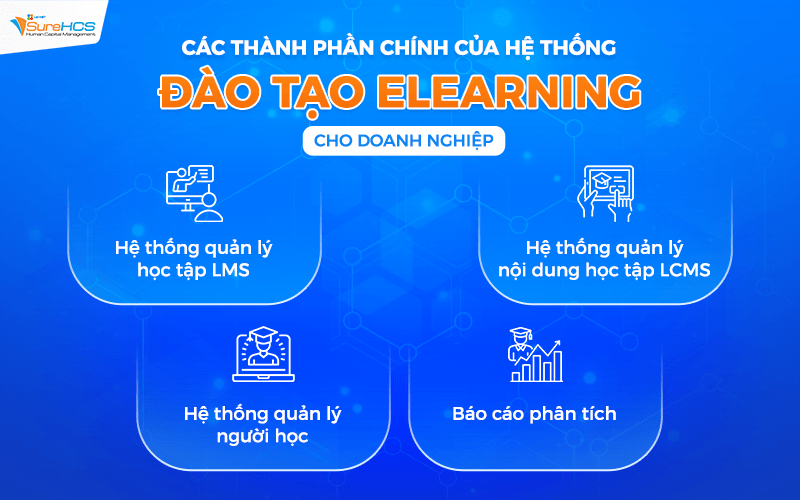
A system eLearning (or system online training eLearning) is not merely a storage place lectures online which is a platform that integrates many tools to help businesses organize, manage and measure training effectiveness in a comprehensive way. Here are the core components that businesses need to understand to operate efficiently in this model.
2.1. LMS – Learning Management System (learning management)
This is the “heart” of the model system eLearning. LMS helps enterprises to manage the entire training activities from creating courses, allocation of students, tracking progress to evaluate the results.
For example, hr can create a roadmap training for new employees, including lock “the company”, “Regulations, timekeeping, and payroll” and “corporate culture”. The system automatically recorded the percentage completed, quiz scores, export a report for each individual.
2.2. LCMS – Learning Content Management System (management System, learning content)
If LMS is the place to hold the course, then the LCMS is precisely the tool to help businesses build and manage training content. This system allows easily create sermons, videos, multiple choice questions or situations simulator without programming skills.
The strong point of the LCMS is the ability to re-use the content, i.e., a document can be edited used for many different courses. This helps businesses to save up to 30-40% of the cost of content development training each year (as reported eLearning Industry 2024).
2.3. Management system the learner (User Management)
This ingredient is responsible for the authorization, recordkeeping, monitoring the learning process of each employee. The administrator can easily know who has completed the course, who's pause, parts which need more support.
For example, if an employee belonging to the accounting department has not completed training course “policy Update personal income tax”, the system will automatically send reminders, report to the management directly.
Thanks to that, the management of hundreds or even thousands of employees in the enterprise becomes automatically more accurate, significantly reducing time tracking of personnel.
2.4. Report analysis (Analytics & Reporting)
A system online training eLearning effective indispensable tool data analysis training. This feature helps managers measure:
- The participation rate, complete the course;
- Point average and school performance in each skill;
- Effective comparison between the training program.
Thanks to the detailed data, the business can determine how courses are bringing real value, which need improvement. According to the LinkedIn Workplace Learning Report 2024, 79% professional L&D (Learning & Development) for that the use of training data to help them improve efficiency training program at least 20% (source).
Overall, four ingredients on creating a solid foundation for a system of eLearning, modern helps enterprises not only the management but also optimized the whole process of training employees. When deployed properly, this model not only save costs but also create culture of continuous learning key elements help to organize sustainable development in the digital era.
3. Benefits of the system e Learning for business
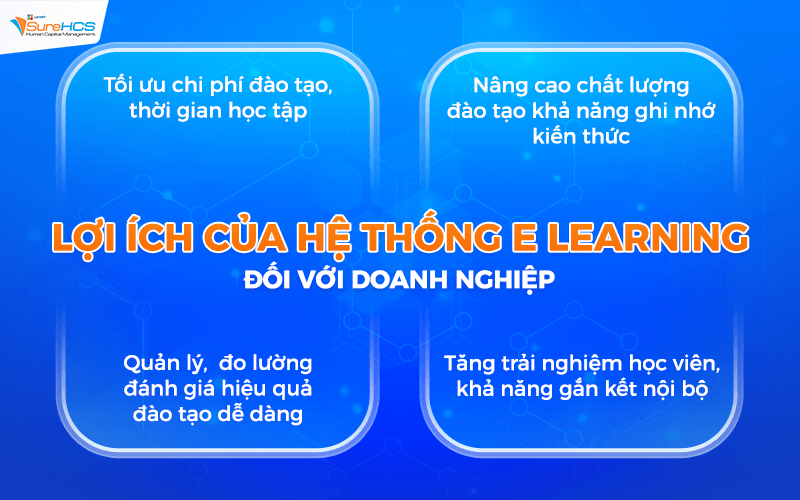
3.1. Optimal cost of training, learning time
One of the biggest challenges with the current business is the cost and time for staff training. Held live classes usually require a big budget for hiring faculty, printing materials, venue hire, travel time of students. For organizations that have a scale of hundreds or thousands of employees, costs are not small.
The application of eLearning systems to help businesses solve radical to this problem. When training content is digitized, employees can learn anytime, anywhere without the need to focus at the same time in one location. This is especially useful for businesses with multiple branches or personnel working remotely.
According to the report of IBM Training Report (2023), the organization of system development, online training, eLearning can save an average of 40% of the cost of training compared to traditional form, at the same time work productivity of employees increased to 50% thanks to the ability to learn, flexibility, update their knowledge quickly.
For example, a retail business, has more than 2,000 employees have moved from training to pattern eLearning, only after 6 months of training costs reduced by almost half, while the percentage of completion of the course, reaching more than 90%. This is clearly evidenced for the actual efficiency that the system online training eLearning brings.
3.2. Improve the quality of training the ability to memorize knowledge
Not only save cost, eLearning also bring experience learning more efficient for staff. Instead of acquiring knowledge one way, from the instructors, learners can interact directly with content through videos, quick quiz (quiz), situation simulation or discussion forum. This approach helps employees remember knowledge longer, can immediately apply to real work.
A study by Research Institute of America (2023) indicate that the rate of memorization of information when learning through eLearning reach 25-60%, while the form of traditional only about 8-10%. The cause is because of the eLearning allows learners to re-learn many times, review the content at any time help to consolidate knowledge continuously.
With respect to the business need professional training as deep as skills, occupational safety, production process, or business of customer service, the application system, online training, eLearning also help ensure all employees have access to content consistently and latest updates.
3.3. Managing, measuring and evaluating the effectiveness of training easy
One of the strongest points of the system eLearning is the ability to digitize and report detailed data. With tools, learning management (LMS – Learning Management System) integrated in the system, managers can track the progress of each employee, the rate of completion of the course, the score or the level of interaction.
This data is aggregated into visual reports, which helps the hr department reviews the training effect, make decisions more accurately plan for capacity development. The measuring instrument can thus not only help business optimization training content, but also direct links to the competency framework and policies on rewards and advancement of employees.
For example, when the system shows group of employees, business results, higher education, proportion of key application even better after the training course sales skills, the hr department may view this as grounds to evaluate performance, building training program lifting high the next.
3.4. Increased experience students, the ability to mount internal
A training program is effective not only in imparting knowledge but also to create a motivational learning fun for students. The model system eLearning is now often integrate elements of “gamification” i.e. turn the learning process into a game with points, prizes, rankings, achievement badges.
This approach helps employees feel inspired, like healthy competition and complete the course faster. At the same time, the system can also automate the certificate or send greetings when students achieve better results, create recognition, encourage lifelong learning.
In general, online training, eLearning not only saves cost, but also bring strategic value in the development of human capacity – core elements to create competitive, sustainable business in the digital era.
4. 5 Elearning Systems for business the most effective on the market
4.1. Hệ thống Lạc Việt E-Learning
Lạc Việt E-Learning là hệ thống đào tạo trực tuyến toàn diện (LMS) do Công ty Cổ phần Tin học Lạc Việt phát triển. Giải pháp giúp doanh nghiệp triển khai chương trình đào tạo nội bộ hiện đại, linh hoạt, đáp ứng yêu cầu “học mọi lúc – dạy mọi nơi”.
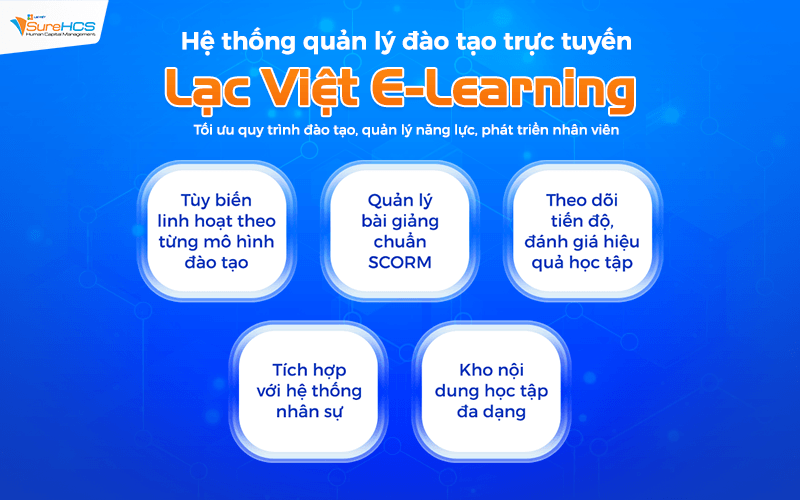
The system is designed to fit for any size organization, from small and medium enterprises to large corporations with two forms of deployment:
- Rental software (SaaS): an enterprise does not need infrastructure investment, just use the system Lac Viet.
- On-premise deployment: installed directly at the enterprise, in accordance with the requirements of high security, custom private.
| Features | Detailed description |
| Design & management course |
|
| Organizational learning materials, learning activities |
|
| Test – Review – report |
|
| Management, user experience practitioners |
|
| Integrated extensions |
|
LAC VIET E-LEARNING – SOLUTIONS, PERSONNEL TRAINING, INTERNAL BUSINESS PERFORMANCE MEASUREMENT
Lac Viet E-learning is the trusted choice of many large corporations such as FrieslandCampina, PV GAS, Shinhan Bank... with more than 100,000 users across the system.
LV E-Learning is not just a training system online, which is the platform that helps businesses build human capacity in a sustainable way. The solution is designed to solve the fulness of the problem: training – measurement – develop – retain talent in the work environment is great.
- Difference of LV E-Learning lies in the ability to combine flexibility between technology, learning experience and management training. Businesses can deploy according to the SaaS model or on-premise, easy to integrate with existing systems
- In compliance with the international standards such as SCORM, OpenBadges, ensuring standardized and scalable long term.
- Don't stop at the “bringing material up system,” LV E-Learning create learning environments multimodal: online class, learning materials, multimedia, forum for exchange of knowledge, exam – assessment – certificate automatically.
- The entire learning process of the employees are tracking, analysis, reporting in real time, to help businesses accurately assess the effectiveness of training and the level of capacity development.
- Modern interface, high security, automation, deep, ability to analyze training data to help businesses optimize the cost of training, improve work productivity, increase employee engagement.
SEE DETAILS MANAGEMENT FEATURES TRAINING LV E-LEARNING AT HERE
Ready to elevate effective internal training in your business?  Contact us Lac Viet today for advice model implementing E-Learning in accordance with the scale, industry and development goals of the business.
With version Cloud, LV E-learning can deploy fast in 7 daysno need to invest in infrastructure, high security and are willing to expand to tens of thousands of users.
SIGN UP TO RECEIVE DEMO NOW
CONTACT INFORMATION:
- Hotline: 0901 555 063
- Email: [email protected] | Website: https://www.surehcs.com/
- Office address: 23 Nguyen Thi Huynh, Phu Nhuan, ho chi minh CITY.CITY
Table advantages and disadvantages
| Criteria | Advantages | Cons |
| Features | Comprehensive learning materials, virtual classroom, test, report, SCORM, OpenBadges | Some features AI enhanced only when integrated SureHCS |
| User experience | Modern interface, easy to use, multi-platform (web & app) | Need the original manual for admins not familiar LMS |
| Integrated | Good link with ecosystem software lacviet | Connect external ecosystem need extra configuration API |
| On-premise | Flexible: SaaS or On-premise | With On-premise deployment time longer |
| Security & stability | International standard ISO, CMMI, ITIL | Need periodic maintenance to optimize performance |
Quote details (reference)
| Service pack | Description | Starting price (VND/month) |
| SaaS – rental software | Business use direct system of Communication without need infrastructure investment. Including updates & periodic maintenance. | From 4.000.000 VNĐ/month, depending on the number of users & courses |
| On-premise – deployed at enterprises | Install, configure, deploy, package, integrate internal systems business. | From vnd 80,000,000 VND (cost copyright + initial deployment) |
| Customize & extend | Optional integrated SureHCS, AI Trainer, interface design, own brand. | Quotation according to the actual requirements |
4.2. System online training elearning Moodle LMS
Moodle LMS is the open source platform, the world's leading eLearning, which is more than 200 countries with thousands of organizations use. Businesses can self-install customized systems to deploy online training or combination of direct – online (blended learning).
Detailed features
| Features | Detailed description |
| Course management flexibility |
|
| Interactive learners |
|
| Monitoring and evaluation learning outcomes |
|
| Open wide and integrated |
|
Table advantages and disadvantages
| Criteria | Advantages | Cons |
| Features | Open source, flexible, can community plugin big | Need IT technicians to install, maintain |
| Cost | Software for free, only cost hosting and custom | Free maintenance, custom or hire professionals |
| User experience | Full online learning tools, easy to expand | Default interface not optimized, need customized |
| Integrated | To connect with teaching tool other (Zoom, MS Teams, Slack...) | Some plugins are not compatible with new |
| Security | Community regular updates patches | Depends on the system administrator internal |
Quote details (estimated deployment in Vietnam)
| Cost item | Description | Reference price (USD) |
| Configuration settings | Set the server, database configuration, theme basic | 10.000.000 – 20.000.000 |
| Hosting + Domain | Capacity 50–100GB bandwidth 1TB/month | 1.000.000 – 2.000.000/month |
| Custom interface & plugin | Identity design business, add plugin learning | 5.000.000 – 15.000.000 |
| Maintenance & upgrades | Technical support, security updates periodically | 3.000.000 – 5.000.000/month |
4.3. Foundation online training e learning elearning industry
Elearning industry is the foundation training online in the cloud (cloud-based LMS) developed by Epignosis (Greece), geared to the small and medium enterprises need to deploy training fast, flexible, without the need for infrastructure investment.
The system is designed to set the course for a few minutes, support management students, track progress, evaluate the effectiveness of learning on the same platform.
Detailed features
| Features | Detailed features |
| Manage, create courses |
|
| Organizational learning, interactive |
|
| Analysis report |
|
| Custom integration |
|
Pros and cons
| Criteria | Advantages | Cons |
| Features | Easy to use, fits small and medium enterprises, rapid deployment | Limited customization features in-depth |
| User experience | Interface friendly learning on mobile smooth | Simple design, yet optimal for students in need of intensive |
| Integrated | Support Zoom, MS Teams, Slack, Google Meet | API enhanced only in the Premium package |
| Reporting & analysis | Dashboard intuitive, automated reporting | Advanced reporting (ROI) only in premium package |
Quote details (according to months, 2025)
| Service pack | Description | Price (USD/month) |
| Starter (Up to 40 users) | Create basic course, management learning, SCORM | ~69 USD |
| Basic (Up to 100 users) | Custom interface, API integrations, reporting details | ~149 USD |
| Plus (Up to 500 users) | More features SSO, branding, automations | ~279 USD |
| Premium (1,000+ users) | Advanced reporting, technical support, priority | ~459 USD |
| Custom (Enterprise) | Customized according to the scale and business needs | Contact for quote private |
4.4. System Docebo LMS
Docebo is system LMS premium comes from Italian, is more than 3,000 global organizations use. The striking platform with potential applications in artificial intelligence (AI) to personalize route learning, data analysis, process automation training.
Docebo fit large enterprises or multinational corporations who needs to manage large-scale training, measuring the effectiveness of investment (ROI).
Features
| Features | Detailed features |
| Manage learning content |
|
| Smart learning |
|
| Analysis & performance measurement |
|
| Customized & integrated |
|
Pros and cons
| Criteria | Advantages | Cons |
| Features | Strong background on AI, learning data analysis | Admin interface slightly complex |
| User experience | Highly customizable, students can experience personalization | Need training administrator original |
| Integrated | Well connected with major systems (Salesforce, SAP, Workday) | Free deploy highly integrated |
| Effective training | Measure ROI and capacity clear | Not suitable for small business due to the high cost |
Quote details (according to the year 2025)
| Service pack | Description | Price (USD/year) |
| Growth Plan (Up to 300 users) | Learning management basic integrated SCORM | ~25,000 USD/year |
| Enterprise Plan (500-5,000 users) | Smart learning, AI, advanced analytics | ~50,000 – 90,000 USD/year |
| Unlimited Plan (5,000+ users) | Custom API connection system, 24/7 support | Contact for quote private |
5. Online training with SAP SuccessFactors Learning
SAP SuccessFactors Learning is a part of the solution SAP SuccessFactors HXM Suite helps businesses closely linked data training with personnel administration.
This is a top choice for corporations, big business wants to build ecosystem learning – development – capacity assessment on the same platform.
Detailed features:
| Features | Detailed features |
| Manage comprehensive training |
|
| Associative learning (Blended Learning) |
|
| Measure effectiveness analysis |
|
| Integrated ecosystem, SAP |
|
Pros and cons
| Criteria | Advantages | Cons |
| Features | Deep integration with hr management, comprehensive life-cycle training | Too complicated for small business |
| User experience | Interface standard SAP, stable mobile support | Less flexible about custom interface |
| Integrated | Good connection with HR, ERP, Performance | Free deployment and maintenance of high |
| Management efficiency | Sync data capacity – training – development | Need IT/SAP Admin operation |
Quote details (according to the year 2025)
| Service pack | Description | Price (USD/year) |
| Core Learning (500 users) | Management basic training, SCORM reports | ~30,000 USD/year |
| Professional Learning (1,000+ users) | Associative learning, mobile certificate, integrated HR | ~60,000 USD/year |
| Enterprise Learning Suite | The entire module HXM integrated (Performance, Career, Analytics) | ~100,000+ USD/year |
5. The pattern eLearning popular in the business
When the organizations and enterprises are to find out information about system internal trainingone of the important factors to consider is the deployment model. Depending on the scale, budget, and level of readiness on technology infrastructure, businesses can choose between many models system eLearning different to optimal performance. Here are four common pattern now, along with the practical analysis of the value that each model brings.
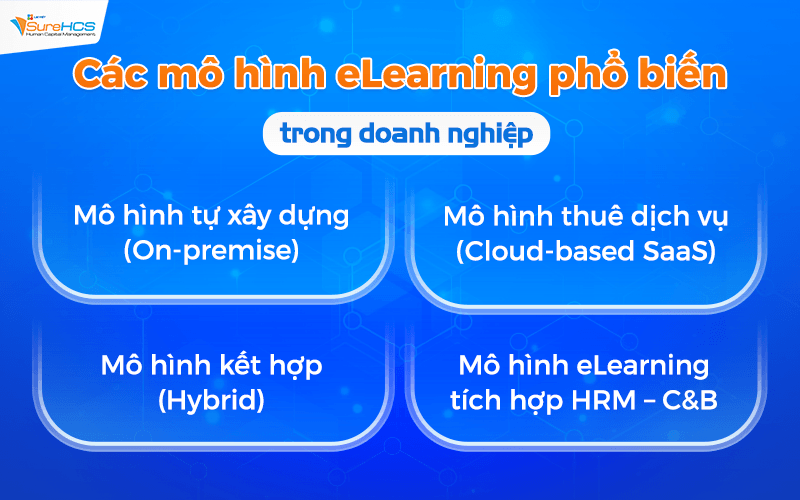
5.1. Model self construction (On-premise)
In this model, business development, eLearning systems, operating entirely on internal infrastructure. Whole data, content, training, account learners and learning history is stored in server's private business.
Advantages:
- Complete control over data, security information – important factors to the business in the field of finance, banking or manufacturing process internal complexity.
- Easily customize functions, interfaces, reports according to the specific characteristics of the organization.
Restrictions:
- The cost of the initial investment is high due to purchase servers, software copyright, hire technical team to maintain the system.
- Deployment time, ask IT skill internal strength to stable operation.
Actual value: with Respect to large-scale enterprise model, on-premise help ensure full control over the training data and absolute security. For example, a manufacturing conglomerate multinational can use the internal system to skills training, operating machinery for thousands of employees without risk data leakage.
5.2. Pattern hire service (Cloud-based SaaS)
This is the most popular model today, when businesses use systems training eLearning online by the Tuesday provided in the form of software services (Software as a Service). The whole system is operated on the cloud platform, businesses only need to pay a fee per month or year.
Advantages:
- Rapid deployment: no need to invest in servers or the technical operation.
- Cost flexibility: consistent both with small and medium business.
- Always new updates: suppliers often feature upgrades, patches, updates interface, support content.
Restrictions:
- Depends on the provider of access speed, security capabilities.
- Unlimited levels of deep customization for business has particular requirements.
Many small and medium enterprises selection of eLearning systems based on the Cloud platform because of lower cost by 30-50% compared with self-development. With the business needs, staff training, sales, customer care or soft skills, here is the solution flexible save the most.
5.3. Model combination (Hybrid)
Hybrid model is a combination of two forms of on – business storage of important data on the system internal (On-premise), but use Cloud services for operations online training eLearning.
Advantages:
- Balance between data security, scalability flexibility.
- Fit large business with multiple departments, branches, or that requires the storage content separate training.
Restrictions:
- System management more complex, the need for coordination between the IT department and service provider.
- Maintenance costs are usually higher than the Cloud model pure.
Actual value:
This is the optimal choice for businesses that are in the transition period number. For example, a bank can store content, training, legal compliance on internal server, while deploying courses soft skills through Cloud platform to employees nationwide can access easily.
5.4. Pattern eLearning integrated HRM – C&B
This is the new trend in hr management, modern, when the system eLearning is directly connected with software hr management (HRM) policies and compensation benefits (C&B).
How it works:
- When employees complete the course, the system automatically updates the results to personnel records.
- This data can be linked with competency framework, roadmap advance of each location.
- Hr can use the results of training as the basis for the evaluation, performance review and reward or appointed.
Actual value: integrated Model helps enterprises not only training but also turn training into development tools, comprehensive capacity.
In summary, the choice of model system, eLearning suitable depends on the strategic objectives, the scale, the budget of each business. If the goal is cost savings with rapid deployment, the Cloud model will fit. If the priority security and the ability to customize the depth, on-premise or hybrid is the optimal choice. Meanwhile, business look forward to building the roadmap development human resources long-term should consider models with integrated HRM – C&B to align training with hr strategies overall.
6. Selection criteria eLearning systems suitable for business
To successfully implement the system, online training, eLearning, businesses need to clearly define selection criteria suitable foundation, not only based on the feature list that is more important than the training effect, the ability to integrate in ecosystem management personnel. Here are the important criteria to help businesses evaluate and choose more accurate.

6.1. Core features meet the demand for practical training
A system online training eLearning effective to meet the basic needs of both learners and managers. Businesses should prioritize the platform are:
- Function course management, roadmap training: allows to program design, learning level employees, departments, or skills.
- Management students, certification, competency assessment: to help businesses easily monitor the progress, the rate of completion of the course, the training effect.
- Gamification (game turned the process of learning): increase interaction, and motivate learning. Staff said they felt more motivated when learning on the platform has gamification elements.
- Ability to learn multi-device: allows employees to access lessons anytime, anywhere via your computer or your phone, special matching pattern work hybrid today.
These features not only help businesses optimize the performance of training but also building a culture of active learning, more cohesive between the departments.
6.2. The ability to integrate with hr systems out there
One of the factors that determine the success of the model e-Learning system is the ability to seamlessly integrate with other software in the enterprise, such as HRM (hrm), C&B (attendance – payroll) or system capacity assessment.
For example: when the system e Learning is connected with software, HRM, data on academic results can automatically update on employee records, support for the process of review, bonus, salary increase or promotion to help the hr department to significantly save time and data entry, reduce errors, data.
6.3. Scalable, flexible, customizable
Business should select the model system, eLearning has the ability to expand in scale development. When organizations increase the number of staff or need additional training modules on the new system remains stable operation without the need to change the platform.
In addition, the ability to customize, interface language, the course structure under corporate culture also helps to increase the learning experience and brand identity internally.
6.4. Security, technical support
Academic data, records staff competence as strategic assets of the business. Therefore, the system should ensure that standard information security (ISO 27001, SSL, data encryption), there is policy backup, recovery, clear data.
In parallel, businesses need to focus on quality technical support after deployment. A reliable supply usually have 24/7 support team, documentation, full channel feedback quickly to handle the problem.
6.5. Deployment costs in accordance with the scale training strategy
The investment cost for eLearning systems should not only be looking at the angle “purchase price software”, which should be overall rating based on effective training, operating costs and the level of long-term maintenance.
With small and medium enterprises, can choose the subscription form (SaaS) to optimize the initial cost; while large enterprises can choose to deploy on-premise to ensure the security, deeper customization.
In summary, choose system online training eLearning matching is important step to help businesses transition from model training traditional to digital media. A system is properly designed target not only help optimize costs, increase academic performance, but also contribute to the capacity development team – a solid foundation for strategic hr long term.
Thanks to the integration of the essential feature of this training system online eELearning from Vietnam not only help business save cost, time, training management, but also improve the quality of learning, creating a culture of learning, continuous in capacity development staff. The organizations and enterprises are to find out information about software training eLearning can see this is a choice worth considering when you want to deploy a system, eLearning, internal, powerful, easy to use, has the ability to expand in scale.