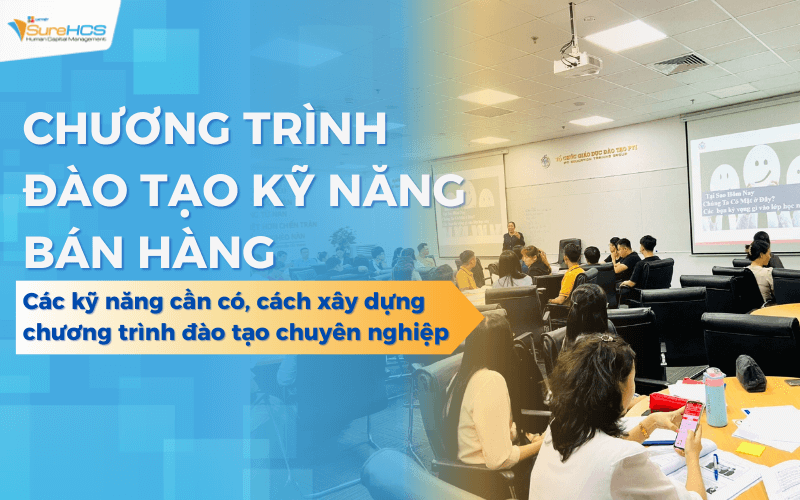






Frame training program staff is the overall plan oriented content, goals, methods, duration of training for each group of personnel in the enterprise. Frame program usually include: identifying training needs, sorting the objects of study, building content according to skills – professional choice training forms (direct, e-learning...), roadmap development, and evaluation criteria results. This is important tool to help businesses grow team capability systematically effective.
Frame construction program, staff training, clear not only help standardize the training content, but also create a “development roadmap” for each specific job position. In the context of business is growing fast or make the switch numbers, the lack of a framework program for training personnel can clearly lead to wastage of resources, staff skills not up to the job requirements and the difficulty in managing performance.
The goal of this article Lac Viet SureHCS will help the organizations and enterprises understand:
- The concept of frame training program staff;
- Practical benefits when frame construction program basically;
- How to build the frame training in accordance with the characteristics each organization;
- And supply model train frame of reference, ready to apply practically.
1. Frame program, staff training, what is?
Frame program staff training is a system of structures training content is designed to be clear, there is orientation to ensure all employees in the business are reaching the right training content according to each stage, location of work and current capability.
Other than a training program single capital only temporary or handle a specific problem, frame the program is comprehensive long-term. Play the role as a “total design” orientation for the entire training activities in the enterprise.
For example, if the training program like a training session skills Excel for office staff then frame the program will include a variety of content: integration, professional skills, advanced training, leadership training... be deployed following the route from the new employees joined until become key personnel.
A frame program, it should be designed based on:
- Target long-term strategy on human resources development of the business;
- Core competencies in each location;
- Results analysis of training needs internal.
In particular, in the training program, personnel, modern frame, the program is platform that helps businesses evaluate the effectiveness of training after each cycle, adjust content to fit with the market, technology, development orientation.
In summary, curriculum, staff training, not only as a tool to help business training the right people, at the right time, the right content but also as a means to create a culture of learning initiative, creating long-term value for the organization.
2. Why business need frame construction program staff training post?
In the context of competitive human resources is increasingly fierce, the business invested in curriculum, staff training, not just activity internal development, but also the long-term strategy to raise competitiveness. A frame training is designed to help standardize skills, enhance performance, reduce hr costs and create team cohesion and active with work.
2.1. Helps to normalize the capacity, skills internal
Frame training is a tool to help businesses standardize capacity of the team according to the standard career and development goals in common. Instead of training discrete, each work location will have a “map” capacity, clear, indicating employees need to learn what, for how long, according to the roadmap of how to reach the standard.
Follow LinkedIn Learning Report 2024, 89% of enterprises have frame training program, it noted the work performance of employees higher than 21% compared to the training institution random. This shows the systematization frame training not only helps quality assurance personnel, which also contributes to maintain consistency in culture, organizational capacity.
2.2. Increased productivity, efficient work
Employees are trained according to frame, standard program understand the objectives, content, criteria, evaluate the results, from which more active in learning and applying knowledge. This is completely different than the form of training and self-development, where employees often do not know I need to learn or learning to do.
The business has a system trained yield higher average profit margin greater than businesses do not have training strategy is clear.
2.3. Reduce the rate of absenteeism, increase cohesion staff
When businesses have frame training clearly, employees perceive opportunities, career development, the investment of the organization for them. Here are the main elements retain talent sustainability.
According to the survey of Gallup 2023, 74% of employees said they are willing to stick long-term if the business can reveal the training capacity development clear. This not only helps to reduce recruitment costs, but also create a work environment positive, promote the spirit of learning internal.
2.4. Optimal cost, measure the ROI of training
One of the biggest benefits of the frame construction training program staff is the ability to measure the effect on investment (ROI). When content, methods, evaluation criteria are standardized, businesses can easily identify expenses which bring real value account would need to adjust or remove.
As practice shows, the organization has the training management system (LMS) attached to the frame program usually save 30-40% of the cost of training each year thanks to reduced holding time, optimize resources and increase the proportion of students completing the course.
In summary, frame training program not only is the plan of learning, but also as strategic tool to help businesses grow human, raise competitiveness, build a culture of learning sustainable.
3. The type of frame the program, staff training, popular with free templates
Every business, depending on the particular operation and development direction, will need the frame program training different employees. The classification of clear the frame training to help organizations optimize resources, deploy the right to demand efficiency, the essence of the development team. Here are 5 type of frame training downloads is more business current applied.
3.1. Frame orientation training for new employees
This is the type of curriculum the most basic is designed for new employees joining the business. The goal is to help them quickly adapt to working environment, understand the corporate culture, operating procedures, and work standards.
A program integration efficiency usually includes the contents such as company overview, instructions, processes, internal regulations on attendance – payroll, benefits policy, the skills needed in the work.
3.2. Frames, skill training, career
Skills training profession to work towards improving the professional help employees perform the work correctly, more effective. The frame of this training is usually designed separately for each position group as production staff, administrative staff, accounting staff, C&B, or professional business.
For example, For employees, C&B (attendance – payroll), the training program could include the module as specified labor law, how to calculate salary according to shifts, social insurance, personal income tax, how to use payroll software automatically.
3.3. Frame, training, leadership
This is the kind of frame training for managers, team or of the personnel potential in the roadmap successor. Content focuses on developing leadership skills, strategic thinking, internal communication and decision making.
A training program effective leadership not only helps in enhancing individual capacity, but also create “culture lead” in the organization. The business has a frame training the clear leader usually owns the team inherited the stable for more than 35% compared to the business not implemented (according to the Harvard Business Review, 2023).
The actual value that the business receives is the initiative in hr planning, to reduce dependence on outside recruiters ensure the next in organizational development.
3.4. Frame soft skill training
Besides professional skills, soft skills play a role is no less important. This is the group support skills employee communication, teamwork, critical thinking, time management efficiency.
The frame construction, soft skill training, help with business formation staff confidence, flexible, adapt quickly to change. For example, the program may include courses such as: effective communication in the environment of skills, conflict resolution, or thinking innovation.
3.5. Frame internal training online
In the era of the conversion of E-Learning become the inevitable trend to optimize the training of personnel. Framework online training to help business deployment flexibility, cost savings, organized, easy to measure effective learning.
A system eLearning modern is typically built on the foundation of LMS (Learning Management System) allows businesses to create the course, assign students, track progress, and evaluate the results right on the system.
For example, in Vietnam, is software lacviet E-Learning, a solution to help business self-designed curriculum, staff training, online, integrated tracking, capacity, performance evaluation and proposal development route, automatically.
Each type of frame training plays a unique role in strategic human resource development. Determining the right type to suit each stage goal will help the organizations and enterprises are to find out information about curriculum, staff training, optimize resources, improve productivity, create a team of strong, long-term commitment.
4. Process frame construction training program staff with standard sample
The construction of a frame training program, employees can't follow or based on the demand arises most the time. Instead, it needs a process logic data base measure is effective. Here are 6 important steps that any business should also comply with if you want to own a training program personnel efficiency, synchronous bring long-term value.

Step 1. Analyze training needs (Training Needs Analysis TNA).
Needs analysis training the first step, the role the foundation for the entire curriculum. Each employee object will have the “gap power” different. Therefore, businesses need to be classified clear:
- New staff: need to understand about culture, business, workflow, basic skills.
- Staff present: usually deficiency updated knowledge or skill enhancement.
- Managers: can lack of strategic thinking skills, and lead team management goals.
Data source analysis should include: KPI has not yet reached, internal survey, feedback from direct management or the capacity assessment periodically.
Step 2. Determine the goal specific training
After understanding the needs, the next step is to identify training goals clear and measurable. A common mistake is to set goals too vague, such as “advanced soft skills” or “improving thinking work”. This leads to difficult-to-control efficiency after training.
Businesses should apply the principle of SMART:
- Specific (Specific): For example, “Understand – apply sales techniques over the phone”
- Measurable (Measurable): reviews by completion rate call scenario test
- Can be achieved (Achievable), realistic (Realistic), there are time limits (Time-bound)
Determining training objectives help business orientation-appropriate content, save time cost.
Step 3. Design training content suitable for each object
Don't have a training program in general which can be suitable for all personnel. Businesses need to split content based on role, current, capacity, and reveal the career development of each group:
- New employees: priority training cultural integration, workflow, basic skills
- Expert staff: need to update skills, in-depth new technology or standardized business.
- Management level middle/high: should focus on leadership skills, decision-making, goal management, performance management team.
The stratification content to help optimize program effectiveness training personnel to avoid wasting resources, reduce the rate of employees feel “not right needs”.
Step 4. Choice of method form the proper training
After the content, businesses need to determine how to deploy the most effective. Some common methods:
- Training direct in situ (on-the-job training): suitable to practice skills, to mentoring, but hard to expand bulk.
- Training through E-learning: flexibility in time and cost savings, but the effect depends on the ability to self-study.
- Mentoring (mentoring), coaching (coaching): suitable for group leadership or strategic location.
Advantages and disadvantages of the methods of training personnel should be evaluated carefully to choose the suitable model with resources, organizational culture. For example, business technology can prioritize form of online learning to fit in with employees familiar digital manipulation, while factory back training suit directly at the school.
Step 5. Time planning, budgets, training
A frame program good always comes with the implementation plan details. Businesses need to determine:
- Training takes place periodically or according to a campaign?
- Each course lasts how long, repeat a few times during the year?
- The budget should allocate how between groups of objects?
For example, new employees may need to budget more in the early stages to ensure the fast entry. Meanwhile, with the management, the cost should focus on intensive courses are outside expert or training program 1:1.
Another little trick to optimize cost, but still ensure the quality is to use a combination of internal training and external at the same time leveraging the digital platforms as the software Elearning to replicate content, effective training.
Step 6. Design evaluation tool training results
Finally, the integral evaluation system to verify the effectiveness of training. A number of tools should be:
- Test input – output: measurement level.
- Feedback after training from students, superiors, colleagues.
- Track index performance work after applying knowledge learned.
The results of this evaluation not only reflect the quality of the program, personnel training, but also as basis to improve the content and methods in the following cycle.
5. Development programs for training personnel to note anything?
The frame construction training program, it is just the beginning. To deploy effectively bring practical value, businesses need to note a number of important factors in the process of organizing training:

- Need to have consensus from middle managers
Management's primary medium is the bridge between strategy training and practices deployed in the team. If there is no consensus active participation of the management level, the program is easy to fall into a state of “on the bottom do not listen” or deployment form.
For example, When organizing training programs, personnel skills, effective feedback, if the head does not apply, or encourage, lower level employees will see the light content and do not change behavior.
Therefore, businesses need to clarify the role of management level in the training plan, can even own training for this group in advance to ensure effective spread.
- Flexible design fits with the context of practices
Don't have a frame, a training program that complies with all organizations. Every business has the scale, field, culture, and the pace of development, different, requiring the program needs to be custom fit.
For example, with manufacturing enterprises, the training content can focus on operating procedures, occupational safety, skill manipulate machinery. Meanwhile, business technology, will focus on soft skills, innovation or Agile project management.
The design flexibility not only help employees acquire easier but also help businesses avoid wasting resources for the content unrealistic.
- Prioritize practicality avoid cramming theory
A common error in training is focused too much on theory, model, concept, prompting the school is “about information” that can not apply.
Instead, businesses should build the program for training personnel in the direction of “learning what to do to be”, matching the real-life situations, case study, simulation, daily job or group exercises to increase the likelihood of knowledge transfer.
The content the app will help employees remember longer, improve work productivity is evident results after training.
6. A number of tools to support building, deploying frame training program effective
In the digital age, the application of technology to enhance the training effect is the inevitable trend. Here are a number of tools that are many businesses use when building and deploying training program hr:
6.1. Management software training (LMS)
LMS (Learning Management System) is the platform allows businesses to manage the entire training process: from planning, organizing classes, track progress, measure results to document storage.
Some management software, employee training LMS popular in Vietnam such as Lac Viet eLearning, Getfly LMS, Topica LMS... are supported organization, staff training, effective, time-saving management and increase transparency.

Software eLearning of Vietnam with over 30 years of experience in the field of providing technology solutions for business, Vietnam has developed an eLearning platform specifically helps the organization of online courses in a professional, flexible personalization according to each business. With friendly interface, easy to use, software eLearning of Lac Viet fully integrated with the features necessary to build an ecosystem of training closed in business:
- Construction management course flexibility: Business can easily create courses, from video, slides, tests, situational simulation... without programming techniques. Each course can personalize by each work location or each stage of training.
- Organization track online classes: The software allows training institutions under many forms: academic freedom (self-learning), learning by schedule (instructor-led), learning combined (blended learning) comes the ability to track progress and score of the reviews individual.
- Rating system, check – certificate: Business can set up the quizzes, exercises, situations, capacity assessment before and after the course, a certificate auto-completion, create favorable conditions for the quality control training.
- Decentralized closely – report multidimensional: Support system decentralized details by department, location, user role; at the same time provide statistical report according to each employee, courses, departments, support management decisions in a timely manner.
- Easy integration with other systems: The software has the ability to connect API with software human resource management (HRM) software OKRs, or the platform, data storage, internal help sync process management human resources and training.
LAC VIET E-LEARNING – SOLUTIONS, PERSONNEL TRAINING, INTERNAL BUSINESS PERFORMANCE MEASUREMENT
Lac Viet E-learning is the trusted choice of many large corporations such as FrieslandCampina, PV GAS, Shinhan Bank... with more than 100,000 users across the system.
LV E-Learning is not just a training system online, which is the platform that helps businesses build human capacity in a sustainable way. The solution is designed to solve the fulness of the problem: training – measurement – develop – retain talent in the work environment is great.
- Difference of LV E-Learning lies in the ability to combine flexibility between technology, learning experience and management training. Businesses can deploy according to the SaaS model or on-premise, easy to integrate with existing systems
- In compliance with the international standards such as SCORM, OpenBadges, ensuring standardized and scalable long term.
- Don't stop at the “bringing material up system,” LV E-Learning create learning environments multimodal: online class, learning materials, multimedia, forum for exchange of knowledge, exam – assessment – certificate automatically.
- The entire learning process of the employees are tracking, analysis, reporting in real time, to help businesses accurately assess the effectiveness of training and the level of capacity development.
- Modern interface, high security, automation, deep, ability to analyze training data to help businesses optimize the cost of training, improve work productivity, increase employee engagement.
SEE DETAILS MANAGEMENT FEATURES TRAINING LV E-LEARNING AT HERE
Ready to elevate effective internal training in your business?  Contact us Lac Viet today for advice model implementing E-Learning in accordance with the scale, industry and development goals of the business.
With version Cloud, LV E-learning can deploy fast in 7 daysno need to invest in infrastructure, high security and are willing to expand to tens of thousands of users.
SIGN UP TO RECEIVE DEMO NOW
CONTACT INFORMATION:
- Hotline: 0901 555 063
- Email: [email protected] | Website: https://www.surehcs.com/
- Office address: 23 Nguyen Thi Huynh, Phu Nhuan, ho chi minh CITY.CITY
Thanks to these specialized features of this software eLearning of Vietnam not only help enterprises shorten the duration of training costs, but also contribute to the formation of a culture of learning internal sustainable.
6.2. The competency framework standardized by industry
The frame construction competencies for each position is the foundation for enterprises to design training content to the job requirements. Each training program will closely follow this framework is to avoid training status “deflected”.
For example: location salespeople need of communication skills, consulting, latch, single, while staff accountant need for capacity compliance processes, analyze data and understand standard financial.
Use the competency framework to help businesses be base rate after training clearly oriented long-term development for employees.
6.3. Foundation e Learning integrated rating/report
eLearning is now no longer merely video lectures. Modern platforms have integrated more features such as:
- Check out the reviews after each module you study
- Track completion rates
- Progress reports according to individual departments
- Route suggestions based learning capacity
Businesses can easily control the quality of the program, personnel training, personalized learning experience for each object, from which the optimal investment performance for training.
Khung chương trình đào tạo nhân viên không đơn thuần là một tập hợp các nội dung giảng dạy, mà là một chiến lược đầu tư dài hạn giúp doanh nghiệp chuẩn hóa năng lực, đồng nhất quy trình nâng cao hiệu quả vận hành. Nếu doanh nghiệp của bạn đang tìm kiếm một giải pháp toàn diện để thiết kế, triển khai và quản lý chương trình đào tạo nhân viên một cách khoa học, hãy cân nhắc ứng dụng các nền tảng công nghệ đào tạo như phần mềm eLearning của Lạc Việt.