



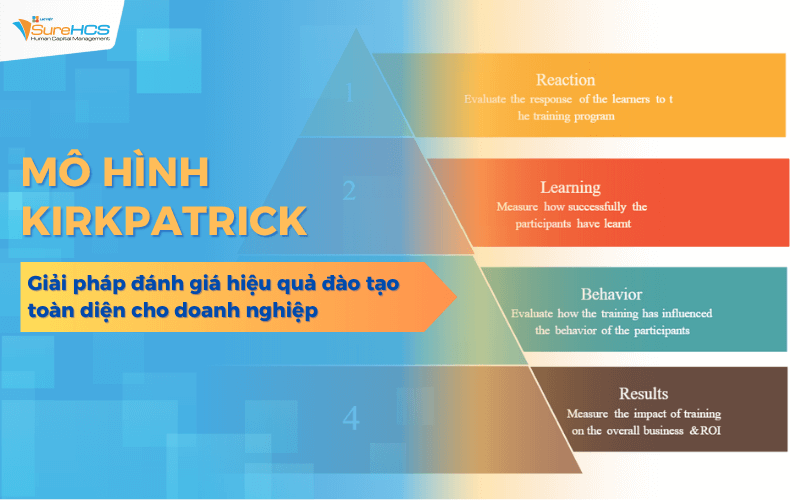
Model Kirkpatrick is a model evaluating the effectiveness renowned training consists of 4 levels: reaction, learning, behavior and results. The first level measure level of satisfaction of students with respect to content, methods, training faculty. Level Monday assess the level of acquisition of knowledge, skills or attitudes after the course. Level three consider the ability to apply what they learn in real work. Finally, level four measure the impact of training programs to business outcomes such as productivity, turnover, or the level of satisfaction of customers. This is the comprehensive model helps businesses determine the unknown value, the actual effectiveness of training activities.
In the process of investing in the training program, most businesses are experiencing a common question: how to know whether the training really effective? The answer lies in adopting a model reviews science objective and systematic. Among the current models, model Kirkpatrick, also known as model review training effectiveness of Kirkpatrick is considered one of the holistic method practices the most.
So the model Kirkpatrick is what? Bring value how? The same Lac Viet SureHCS find out details in this article.
1. Learn overview of model Kirkpatrick
1.1 Model Kirkpatrick is what?
Model Kirkpatrick or model Patrick is a system consisting of 4 levels of evaluation is designed to measure the actual effectiveness of training program. Other than the evaluation methods usually just stop in the collected feel of students, this model going into each floor impact from the initial reaction of the learners ability to apply knowledge on the job, and finally the real impact to business results.
The 4 levels include:
- Reaction (Reaction) – Students feel about the course?
- Learning (Learning) – They learned nothing?
- Behavior (Behavior) – They can apply new knowledge to work?
- Results (Results) – Business achieve what value from the training program?
1.2 historical pattern formation evaluation training Kirkpatrick
This model developed by Donald Kirkpatrick in the late 1950s in his doctoral thesis at the University of Wisconsin (United States). The original is just a rating system in internal teaching but thanks to the high practicality, the model has spread rapidly and is recognized throughout the world especially in the large organizations have training strategy is clear.
1.3. Advantages and limitations of the model Patrick
Advantages:
- Easy to apply, easy to visualize follow each level.
- Focus on results, actual behavior after training.
- Can use as tools for internal communication about the value of training.
Restrictions:
- Measuring behavior, results need long time, and tool support.
- Can omit inputs, context, if no rating from the start.
2. Model comparison Kirkpatrick model CIPP
To choose the method of evaluating the effectiveness of training appropriate business need to understand the characteristics of the popular models today. Here's a comparison between the model Kirkpatrick and model CIPP, the two models are widely used in the corporate environment, education.
Comparison with model CIPP (Context – Input – Process – Product)
| Criteria | Model Kirkpatrick | Model CIPP |
| The main objective | Evaluate effective training from the school to results | Comprehensive review from the planning stage |
| Focus | Response – Learning – behavior – results | The context – input – process – product |
| Time of application | After the training ends | Before – During – and After training |
| Matching | Business focus effective output | Organizations that want to control the entire training cycle |
| The ability to measure real-world impact | High | Average |
Although each model evaluation has value but the model Kirkpatrick featured by the ability to focus on outputs and actual value that the business received after training. This is the reason why this model is being increasingly widely applied in the business-oriented workforce development sustainable, taking efficiency as the center. If businesses are looking for solutions reviews effective training, Kirkpatrick is the option worth considering.
3. Why model Patrick is global enterprises use?
The main reason lay in the wide application and possibility of the direct link between training – effective business. Model Patrick help businesses answer these core questions:
- Training can change the behavior staff?
- Employees can work more efficient?
- Can improve on productivity, revenue or satisfaction of customers?
In particular, in the context of business increasingly need to demonstrate the ROI (rate of return) from training activities, this model helps leaders perspective clearly has the facility to continue to invest in the right direction.
In addition, the model Kirkpatrick can flexibly apply for all internal training, soft skill training and programs to enhance technical expertise. Thanks to that, it suits both small and medium enterprises and multinational corporations.
Business should choose the model Patrick in the case of:
- Want to clearly demonstrate the efficiency of private training with the leader board.
- Need to measure the impact of specific training to job performance.
- Just held a number of intensive training want to track behavior and results.
- Want to improve the quality of training programs through multidimensional assessment.
4. Model Kirkpatrick include some level?
Pattern reviews effective training of Kirkpatrick, also known with the name brevity is the model Patrick divided the evaluation process into 4 logic levels closely linked with each other. Each level reflects a particular aspects of the training effect from perceived subjective original to the real impact in terms of organization and business. Below is a detailed analysis of each level:
4.1. Level 1 – Reaction (Reaction)
Objective: to assess how learners perceive, react to the training program.
This is the first step and is also easy to implement. Businesses need to understand students evaluate how about content, method,, faculty,, duration, degree of usefulness of the school. If the initial response is negative, the ability to students to acquire knowledge, practical application will be very low.
For example: After the end of the training, selling skills, staff are asked to fill in a survey form reviews 5 questions, as: “content has the right to expect not?” “The pace of teaching is appropriate not?” “Are satisfied about faculty not?”.
How to implement effective: Business should build a table brief survey, focusing on the key criterion encourages students to evaluate honestly. Important is don't stop at collecting feedback that need synthetic put out of action for improvement is clear.
When understood sense learners, businesses can tweak content, method or way of organizing training to increase the satisfaction, at the same time optimal investment budget training.
4.2. Level 2 – Learning (Learning)
Objective: to Measure whether learners have acquired much knowledge, skills and attitude change after the course.
Not only stop in feel, this level helps clearly define the training can create content value true or not.
The measurement method downloads:
- Test before and after training.
- Simulated practice situations.
- Group exercise, reviewer.
- Reviews attitude – motivational work through the survey anonymously.
Suggestion tool support:
- Businesses can integrate E-learning platform to create multiple-choice test automatically.
- Applied software training manager features track learner progress and periodic reviews.
When the effectively applied this level, the business will capture the correct “output of knowledge” of the program, from which timely adjust material, method, or route training accordingly. In addition, this is clear evidence to demonstrate the value of training with the leader board.
4.3. Level 3 – behavior (Behavior)
Objective: to assess the level of change the actual behavior of the learner after applying knowledge to work.
Core question at this level is: “Employees can actually apply what they have learned not?” This level is difficult to measure, but closely reflects the real value of training.
Frequent difficulties:
- Behavior change usually takes a long time to observe.
- The work environment does not support, management does not follow the staff difficult to maintain new habits.
- Teen rating system periodically and multi-dimensional responses.
Proposed solution:
- Combine reviews from direct management or group of colleagues.
- Using the tool, 360 degree feedback, or personal interview after 1-3 months.
- Recorded behavior by KPIs specific (for example: number of times the app skills to handle objections in sales).
Business benefits received:
As well as this level, the business not only evaluate the effectiveness of training but also built a culture of learning and continuous innovation.
4.4. Level 4 – results (Results)
Objective: to Measure the ultimate impact of the training program to the business objectives and the organization.
This is the highest level, the most valuable. It answers the question: “the training Program brought no result for the organization?”
A number of indicators to measure efficiency level 4:
- Labor productivity increased by how much percent.
- The percentage of errors in the process of reducing how.
- Retention personnel improve out why.
- Revenue or profit growth after training does not.
Data analysis support: the Enterprise should establish management systems, effective training panel (dashboard), connect the data from the personnel department, finance, business to take out comprehensive review.
When measurable results, level 4, training department is no longer a “necessary expenses” which became an investment strategy contribute directly to business performance.
Understanding and full implementation of the 4 levels in the model evaluating the effectiveness of training of Kirkpatrick not only help businesses look at the role of training but also optimized the budget, building, strategy development, sustainable. This is a model that any organization focused on the quality of human resources should also consider adopting.
5. Benefits when applied model Kirkpatrick in business
Applicable model evaluating the effectiveness of training of Kirkpatrick not only help businesses measure the success of a training program, but also create a platform to raise the entire strategy human resource development. Specifically, the outstanding benefits that this model brings include:
- Cost control training more effective
Staff training is a big investment, but if no measurement is effective, this investment to become cost waste. With model Kirkpatrick, businesses can clearly assess each level impact of the training program, from the feel of learners to result in actual trading. Thanks to that, businesses know which investments would bring real value, account should be adjusted or cut.
- Improve the quality of the program, avoid training form
One of the strengths of the model Patrick's put the focus on behavior and real results instead of just stopping at level theory eliminates training status form only school to complete targets without creating changes in the work. Thanks to that, the business can adjust the content, methods, who taught stars for with job demands and the actual capacity.
- Mount training with the strategic objectives of the organization
Through assessment at the level of behavior/results, the evaluation model training Kirkpatrick help leaders clearly see the relationship between training and the long-term goals such as revenue growth, improve productivity, enhance service quality, retention, hr... this is very important in the design of development strategies human resources associated with the direction of sustainable development of the organization.
- Reinforce the belief of the leaders on the value of training
A training program is only truly valuable when can prove to be of impact. Model Kirkpatrick provides quantitative indicators, qualitative clearly help leadership understand that training is not only the fixed costs of the personnel department, which is a strategic tool to create profitable and efficient operation long-term.
6. The note when applying the model Kirkpatrick at the Vietnam business
Although the model evaluating the effectiveness of training of Kirkpatrick has been applied widely on the entire world, but when deployed in real context at the Vietnam business, still there are some points need special attention to ensure model to maximize efficiency.
6.1. Avoid reviews sentiment in levels 3 and 4
Two level end of the model Patrick is the rating behavior (Behavior) and evaluate the results (Results) requires objective data tracking practice. However, many businesses today are still trend reviews “feelings” based on the review of the management or common sense that no specific data. This not only reduces the reliability of evaluation results, but also leads to the adjustable bias in the training strategy.
The solution is to build the index system as clear as KPIS, OKRs, or use the tool to track behavior after training to recognize the change grounded.
6.2. Should synchronization tool reviews in software training
For a comprehensive assessment according to the model Kirkpatrick, businesses need many types of data from the survey feedback, test results, observed behavior to report work performance. The implementation will take time to flaws. So the advice is so integrated assessment tool right in the software internal training or eLearning platform is used. This not only helps to unify data, but also optimal process monitor aggregate results.
6.3. Need internal communications clear to employees understand the goal of the assessment
Reviews should not be the activities impose. When employees do not understand the true purpose of the evaluation according to the model Patrick, they may react negatively or not to cooperate. Therefore, before implementing hr need for clear communication: assessment does not aim to criticize that individual to improve the training program development support long-term capacity. When employees feel heard, and they will gladly provide data honest feedback more fully.
7. Application software eLearning to support model Kirkpatrick
To deploy models evaluate the training effect of Kirkpatrick consistently effective, modern businesses today increasingly tend to apply technology, especially software online training (eLearning) to digitize the entire process of management reviews.
A typical example is software lacviet eLearning solutions, online training, business support, performance evaluation, training according to each level of the model Patrick a coherent easily:
The outstanding features of the supported models Kirkpatrick:
- Store feedback students after each course (Reaction): enables enterprises To collect comments about the content, instructors, training methods through the chart survey sample integrated electronics available.
- Management scores, certificates of training (Learning): track learning progress, test results, complete levels of students, from which to determine the capacity was achieved after the course.
- Integrated board reviews acts, reported results (Behavior & Results): software can connect to the system, KPI management, job or assess the capacity to recognize the behavior change in the work and efficiently contribute to the fact.
LAC VIET E-LEARNING – SOLUTIONS, PERSONNEL TRAINING, INTERNAL BUSINESS PERFORMANCE MEASUREMENT
Lac Viet E-learning is the trusted choice of many large corporations such as FrieslandCampina, PV GAS, Shinhan Bank... with more than 100,000 users across the system.
LV E-Learning is not just a training system online, which is the platform that helps businesses build human capacity in a sustainable way. The solution is designed to solve the fulness of the problem: training – measurement – develop – retain talent in the work environment is great.
- Difference of LV E-Learning lies in the ability to combine flexibility between technology, learning experience and management training. Businesses can deploy according to the SaaS model or on-premise, easy to integrate with existing systems
- In compliance with the international standards such as SCORM, OpenBadges, ensuring standardized and scalable long term.
- Don't stop at the “bringing material up system,” LV E-Learning create learning environments multimodal: online class, learning materials, multimedia, forum for exchange of knowledge, exam – assessment – certificate automatically.
- The entire learning process of the employees are tracking, analysis, reporting in real time, to help businesses accurately assess the effectiveness of training and the level of capacity development.
- Modern interface, high security, automation, deep, ability to analyze training data to help businesses optimize the cost of training, improve work productivity, increase employee engagement.
SEE DETAILS MANAGEMENT FEATURES TRAINING LV E-LEARNING AT HERE
Ready to elevate effective internal training in your business?  Contact us Lac Viet today for advice model implementing E-Learning in accordance with the scale, industry and development goals of the business.
With version Cloud, LV E-learning can deploy fast in 7 daysno need to invest in infrastructure, high security and are willing to expand to tens of thousands of users.
SIGN UP TO RECEIVE DEMO NOW
CONTACT INFORMATION:
- Hotline: 0901 555 063
- Email: [email protected] | Website: https://www.surehcs.com/
- Office address: 23 Nguyen Thi Huynh, Phu Nhuan, ho chi minh CITY.CITY
Practical benefits bring:
- Save time management, data synthesis: Instead of having to handle each form manually, the software helps businesses are visually comprehensive training effectiveness.
- Optimal cost of training for employees: Reduce printing costs, survey organizations, human resources reviews at the same time enhance the quality of reviews thanks to the data the correct number.
- Easy make a decision adjustable training program: When there is enough information on all four levels, the business will easily get to know which course should improve employees need additional training, or weakness in the current program.
If businesses want to deploy the model Kirkpatrick in an efficient manner is application software eLearning such as Vietnam is a stepping stone to help shift from review to review, professional, scientific flexible. Contact to get advice, experience, training solutions most suitable for your business.