





In enterprise environments with modern communication in business is not only soft skills, which are factors that determine the operational efficiency and competitiveness of the organization. A verbal lack of dexterity may cause the project to crash, while a conversation the right way can open up opportunities for the millions of dollars.
This article Lac Viet SureHCS will help the business understand the nature, importance of communication in business as well as the skills necessary to develop a team of hr professional confidence.
1. Communication in business is what?
Communication in business is the process of exchanging information, ideas and feelings between individuals or groups in the work environment to achieve common goals of the organization. Don't just stop at conveying information, communicate also the art of creating influence, build trust and maintain relationships sustainable collaboration in business.
In business, communication can be divided into two main groups:
- Internal communication: Is active swap between the management level, between colleagues or between departments in the organization. The goal is to ensure the consistency of orientation, share timely information, promote team spirit. For example, a group meeting effectively help employees clearly understand the project goals, avoid false when deploying work.
- External communication: Be active exchange with partners, customers, suppliers or the public. External communication demonstrate professional image and brand value of the business, directly affect revenue, reputation in the market.
Communication in business is not just “speaking and listening”, which also includes the ability to understand, the feedback properly. A good employee communication skills can:
- Express ideas clearly, convincingly in the meeting or reporting.
- Know how to listen actively to capture the needs and feelings of others.
- Maintain professional attitude, respect in all circumstances, especially when a conflict.
In the context of globalization, communication skills in business increasingly become core competencies help the enterprise build team cohesion, retain talent, build brand image reputation in the market. Therefore, the training of communication skills in business for personnel not only is an active, personal development, but also the investment strategy to bring long-term benefits for the organization.
2. The form of communication in business popular
Communicate in today's business doesn't just stop at words or text that has developed diverse in many forms, media and various other purposes. Each form carries a unique role in ensuring the free flow of information is transmitted accurately and effectively in accordance with object recognition.
Here are three forms of communication common in modern business.
2.1. Internal communication (Internal Communication)
Internal communication is the foundation to maintain the connection and cooperation between departments, management and employees in the organization. A business can communication system effective internal often have teamwork, higher employee engagement, more ability to make decisions faster.
For example, A company deployed exchange tools such as Microsoft Teams or e-learning platform with integrated exchange forum help employees easily share knowledge, updates, new processes, or to discuss real world situations right in the work environment.
2.2. External communication (External Communication)
External communication is the bridge between business partners, customers, media agency, community. This form of can is “the face of the brand” determines the degree of credibility of the business in the market.
Illustrative example: A business providing services B2B maintain regular contact with clients through webinars, or e-newsletters periodically. How to communicate this to help customers stay updated product information, at the same time strengthen image, professional, and reliable.
Enterprise value received:
- Increase confidence and loyalty of customers.
- Maintain relationships sustainable cooperation with partners.
- Contribute to improving brand reputation expand new business opportunities.
2.3. Communication number (Digital Communication)
In the context of conversion of strong communication number are becoming inevitable trend. This is a form of communication through online platforms such as email, social media, webinar, or the application of project management. This form helps businesses to remove barriers of space, time, special matching pattern work in combination (hybrid).
For example practices: An organization using systems, online training, e-learning of English can easily deploy course on communication skills in business allows employees to learn and interact online with instructor, discuss situations forum, wiki, or join virtual classes anytime, anywhere.
3. Communication skills in business are necessary for personnel
To communicate in the business to bring real effect, hr is not just the ability to express, but also to listener feedback, handle the situation tactfully. In the work environment, modern, where the speed and the pressure always parallel, the possession of communication skills in business to help each individual, more confident, more efficient work.
Here are four foundation skills that every employee should be equipped.
3.1. Skills active listening (Active Listening)
Active listening is not merely “hear the other person say,” that is to understand and respond purposefully.
An employee has the skills of listening are:
- Spend the focus entirely to say, avoid interrupting.
- Noted reflect the contents to confirm properly understand Italian.
- Ask clarifying questions instead of judge or react emotionally.
For example, In a group meeting, when the team presented the idea employees know active listening will notes, question the unknown instead of protest now. This way, help to create environments open exchange professional, where every opinion is respected.
Enterprise value received: Employees understand the right task, reduce errors in enforcement, at the same time improve the quality of coordination between the parts.
3.2. Presentation skills to express ideas
An idea whether or to what also becomes meaningless if it is not transmitted properly. Presentation skills to express ideas help staff expressed the view clear, convincing professional pre colleagues, clients or leadership.
An effective presentation is often guaranteed 3 factors:
- Clear structure: open top attractions, main content, there is evidence, finish latch back message.
- Body language naturally: eye contact, gestures, posture, expressing self-confidence.
- Flexible interaction: ask questions, use illustrative examples to create the connection.
Enterprise value received: Employees have the ability to present coherent help reduce meeting time, increased ability to make decisions quickly, raise professionalism in the eyes of partners.
3.3. Communication skills via email and text
In the work environment is great, the majority of information is exchanged via email, message, or text document. However, errors in wording may lead to misunderstanding or harm to the individual images, the organization.
A professional email should ensure:
- Title clear, concise content, the right focus.
- Intonation polite, avoid writing in all caps or use from emotions.
- Presented scientific, easy-to-read (format bullet or short).
Practical example: An employee NUMBER as email responses to customers by the tone positive, expressing interest really will help to increase the ability to retain customers long-term.
Enterprise value received: Limited conflict, enhance work performance, brand image professional in the eyes of customers and partners.
3.4. Feedback skills, conflict resolution
In the work environment, conflict is unavoidable. Feedback skills and conflict resolution to help employees maintain the spirit of cooperation instead of confrontation.
A feedback constructive (constructive feedback) should:
- Focus on behavior, not personal attacks.
- Give suggestions to improve instead of criticism.
- Select time, contextual fit.
For example: Instead of saying “reports of him so poorly,” let's talk “If you add data in this section, the report will be more persuasive”. This is how feedback helps people get absorbed easily and feel respected.
Enterprise value received: Increase the trust between the members, building a culture of open exchange, promote the spirit of learning, performance improvement, team work.
Communication skills in business above not only help employees develop themselves but also directly enhance organizational effectiveness. Business has a team of good communication will own competitive advantage bigger – from productivity, internal cohesion staff to photo professional brands on the market.
4. Training, communication skills in business for personnel
4.1. Why business need training communication skills?
In the context of the labor market, competition, communication skills in business are considered one of the core competencies help employees work effectively, good cooperation, create a professional image for the business.
Whether it is office workers, sales or management level, the trained about communication skills in business are essential requirements to comprehensive development.
Training, communication skills, bring three core values for business:
- Increase effective coordination of the work: When employees know worded clearly, listening actively, the coordination between the parts takes place smoothly and limit errors.
- Construction corporate culture positive: open Communication helps create a work environment of respect, reliable mounting.
- Increase customer experience: sales Team, customer care, ability to communicate professionally help businesses enhance brand image, and retain customers long-term.
4.2. The method of effective training
Businesses can deploy training program communication skills in business under many forms, depending on the scale, budget, peculiarities of work.
- Live training (Workshops, Role-play, Coaching): in accordance with the training sessions short, focus on practicing specific situation. This method helps students fast reflexes, honing skills, handle conflict or negotiating reality. However, the organization of the costs, depending on the duration and schedule of instructor – student.
- Online training (E-learning, interactive Videos, Microlearning): Is the popular trend in the training business today. This form allows employees to learn anytime, anywhere; may repeat content many times, self-assessment process itself. In particular, when combined simulation tools situations of practical communication, businesses can turn theory into experience practice lively.
A quick comparison of two forms:
| Criteria | Live training | Online training (E-learning) |
| Cost organization | High (location, instructor, materials) | Significant savings |
| Flexibility | Limited time | Learn anytime, anywhere |
| Scalability | Hard open wide for big quantity | Easy to extend for the entire personnel |
| Track & reviews | Crafts, difficult to measure | Management system, automated reporting |
With the advantage of technology, online training, e-learning is becoming the preferred choice of many businesses in fostering communication skills for staff in a flexible way sustainable.
4.3. Application system, online training, e-learning of English
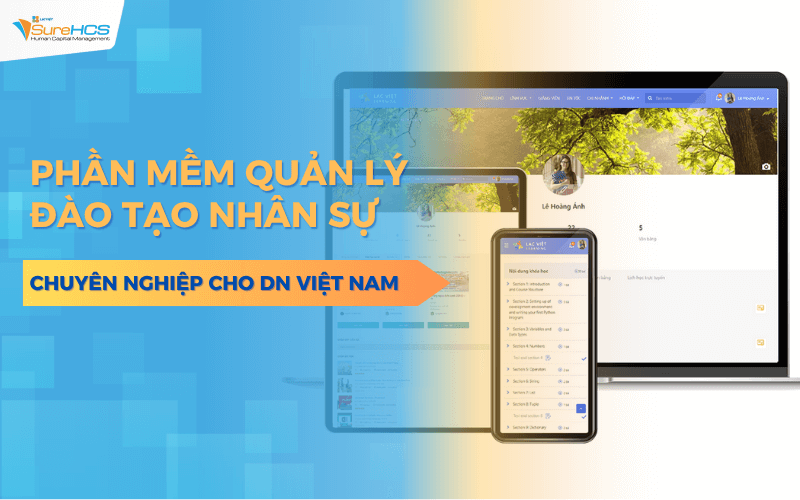
To help businesses optimize processes, training, communication skills, company shares Information Vietnam has developed training platform online Vietnam eLearning – learning solution comprehensive, easy to deploy management.
The salient features of the system:
- Design the course according to international standard SCORMintegrated video, situations, simulations, interactive exercises help students to practice communication skills practice.
- Class organization online (virtual classroom), allowing instructor-led, live reviews.
- Automatically track learning progress, report results and certification after the course.
- Data analysis training, support managers evaluate the effectiveness of learning, measurement of ROI in training.
LAC VIET E-LEARNING – SOLUTIONS, PERSONNEL TRAINING, INTERNAL BUSINESS PERFORMANCE MEASUREMENT
Lac Viet E-learning is the trusted choice of many large corporations such as FrieslandCampina, PV GAS, Shinhan Bank... with more than 100,000 users across the system.
LV E-Learning is not just a training system online, which is the platform that helps businesses build human capacity in a sustainable way. The solution is designed to solve the fulness of the problem: training – measurement – develop – retain talent in the work environment is great.
- Difference of LV E-Learning lies in the ability to combine flexibility between technology, learning experience and management training. Businesses can deploy according to the SaaS model or on-premise, easy to integrate with existing systems
- In compliance with the international standards such as SCORM, OpenBadges, ensuring standardized and scalable long term.
- Don't stop at the “bringing material up system,” LV E-Learning create learning environments multimodal: online class, learning materials, multimedia, forum for exchange of knowledge, exam – assessment – certificate automatically.
- The entire learning process of the employees are tracking, analysis, reporting in real time, to help businesses accurately assess the effectiveness of training and the level of capacity development.
- Modern interface, high security, automation, deep, ability to analyze training data to help businesses optimize the cost of training, improve work productivity, increase employee engagement.
SEE DETAILS MANAGEMENT FEATURES TRAINING LV E-LEARNING AT HERE
Ready to elevate effective internal training in your business?  Contact us Lac Viet today for advice model implementing E-Learning in accordance with the scale, industry and development goals of the business.
With version Cloud, LV E-learning can deploy fast in 7 daysno need to invest in infrastructure, high security and are willing to expand to tens of thousands of users.
SIGN UP TO RECEIVE DEMO NOW
CONTACT INFORMATION:
- Hotline: 0901 555 063
- Email: [email protected] | Website: https://www.surehcs.com/
- Office address: 23 Nguyen Thi Huynh, Phu Nhuan, ho chi minh CITY.CITY
System Lac Viet eLearning is to be deployed flexibly under two forms:
- Rental software (SaaS): an enterprise does not need infrastructure investment, simply log in and use.
- On-premise deployment: in accordance with the organization has high requirements for security and custom.
Experience it now management software training with English eLearning – free trial at https://elearning.lacviet.vn/