




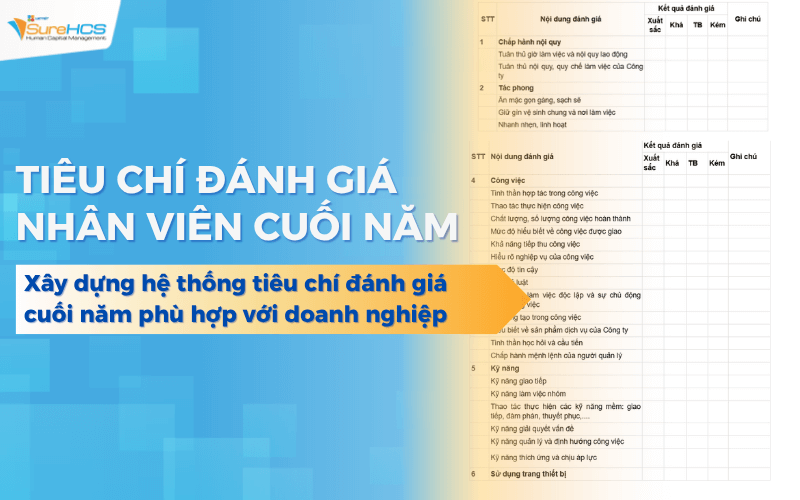
End of the year is always an important time for businesses to sum up the results of operations and capacity assessment team personnel. However, one of the biggest challenges that many organizations encounter is determining the criteria for evaluating employees last year it is fair, objective, properly reflect the value the contributions of each individual.
Criteria for evaluating employees not only is the measurement tool work efficiency, but also the platform that helps business, strategic planning, staff development, out decision the regulation on salaries and bonusestraining promoted a scientific way. A system of matching criteria will help businesses:
- Identify the right talent, the motivation for their continued dedication.
- Detection of weaknesses in the capacity or conduct work to have a plan to improve timely.
- Build cultural assessment transparency, reinforce the belief, the internally mounted.
This article Lac Viet SureHCS will help the organizations and enterprises are to find out information about the criteria for evaluating employees last year to understand the concept, role and how to set up the system criteria in accordance with the sustainable development goals.
1. Learn about criteria for evaluating employees last year
1.1. The criteria for evaluating employees last year is what?
The criteria for evaluating employees last year is the measure of the specific business uses to determine the level of completion of the work, professional skills, behaviour and level of contribution of each employee in a working cycle (usually one year).
These criteria often include both quantitative (such as sales, completion rate KPI, job performance) and qualitative (such as attitude, cooperative spirit, professional responsibility). The combination of these two factors help the evaluation results reflect the more comprehensive the work efficiency, the development potential of employees.
For example:
- With parts business criteria, quantitative rate may be reaching a turnover of 100% KPI.
- With the support department of internal criteria, qualitative may be the level of initiative and ability to coordinate groups.
A system evaluation criteria clear flexible to help businesses ensure fairness, reduce conflict, internal, at the same time motivate the employees to improve capacity.
1.2. Role benefits for businesses
Applying the criteria for evaluating employees last year to bring more real value for the business at all levels of governance and organizational culture:
- To ensure transparency in the evaluation: The criteria clear helps remove elements, sensuality, create trust between employees and management.
- Is the database for the personnel decisions important: assessment results help leaders are clear grounds when considering salary, promotion, training, planning, human resources design. Business system evaluation criteria can effectively shorten 35% of the time decision-making personnel compared with traditional way.
- Increase motivation cohesive team: Staff to see his effort was recorded fair will tend to stick more active in work.
- Support business planning, strategic staffing, long-term: System evaluation criteria are standardized, leaders easily identify team personnel potential, identify competency gaps and planning developmentally appropriate for each department.
In summary, the criteria for evaluating employees last year not only the management tools, but also the leverage strategy to help businesses grow sustainably, building cultural equity, people-oriented as core values.
2. Group of criteria for evaluating employees year-end popular
To ensure the process of evaluating employees last year reflect the true capacity, contribute to the fact, enterprises need to build a system criteria comprehensive balance between “work efficiency” and “human values”.
Here are 5 criteria to assess staff end of the year is commonly applied in organizations today to help business measure human capacity in a scientific transparency.
2.1. Evaluation criteria of performance (KPIS/OKRs)
Work efficiency is the criterion platform, directly reflects the level of completion of assigned goals. Businesses often use Key Performance Indicators (KPIS) – indicator of job performance quantitative or OKR (Objectives and Key Results) – objectives and outcomes key to effective measurement.
Illustrative example
- Sales staff: reach 110% of sales compared with the plan.
- Marketing staff: increase of 25% of the potential customer (lead) in the quarter.
- Accounting staff: ensure financial statements filing deadline 100%.
Enterprise value received: When applying this criterion, the business can fair assessment based on real data, instead of feeling.
Practical hint: Businesses should incorporate KPI (quantitative) with OKR (results-oriented) to fit the measured performance of short-term, medium-oriented long-term development for employees.
2.2. Evaluation criteria of professional ability
This criterion measure the level of understanding, ability to apply knowledge, specialized skills in practical work. Here are important factors help businesses identify personnel has the potential to grow or need more training.
Illustrative examples:
- For technical staff: proficiency level tools, expertise, ability to handle technical errors.
- For administrative staff – personnel: the ability to use software, HRM, understanding the legal process of labor.
Enterprise value received: Enterprises can standardize frame capacity (Competency Framework) to compare the power between the location, as the basis for internal training.
Practical hint: Should split criteria capacity into 3 groups: knowledge – skills – attitude (KSA). For example: communication skills, analytical thinking skills, using digital tools...
2.3. Evaluation criteria of attitude, behavior, work
The effect comes not only from the results of the work, but also from the attitude behavior the daily work of staff. This criterion helps businesses measure the level of professionalism, sense of responsibility, ability to integrate into the general culture.
The elements usually reviews:
- The spirit of collaboration with colleagues.
- Active in work, ability to take responsibility.
- Compliance with rules and core values of the business.
For example: A staff always ready to support team when having a breakdown, or actively propose process improvements, was considered to have positive attitude.
Practical hint: Apply the scale 5 levels of behavior (From “unsatisfactory” to “outstanding”) helps people easy evaluation feedback and employee understand his need to improve something.
2.4. Evaluation criteria of capacity development, creative
In the context of conversion of creativity and the ability to learn becomes important factor for enterprises to adapt development.
This criterion rating:
- Ability to propose new solutions, process improvement work.
- The level of willingness to learn, to acquire technology or new skills.
- The initiative in developing themselves, supports others learn.
Illustrative examples:
- An employee takes the initiative to help save 20% processor time process.
- Marketing executive application tool WHO help increase the conversion rate of the campaign.
Enterprise value get: According to the report of McKinsey 2024, 64% of businesses have criteria creative in employee evaluations to reach a speed of product innovation faster than 1.5 times compared with the group not applicable (source: mckinsey.com). This proves that encourage creativity not only improve productivity but also to promote competitiveness in the long term.
2.5. Criteria for assessment of the level of cohesion, contribute to internal
Team this criterion focuses on the level of cohesion and team spirit and contribution of employees for collective. Here are factors to help businesses measure the effectiveness internal culture, maintaining the work environment positive.
The elements can evaluate:
- The frequency, level of involvement of internal operations, training, CSR.
- Spiritual share, support colleagues.
- Positive influence spirit work in general.
Practical hint: Businesses should combine between personal rating, reviews peers (peer review) to reflect the comprehensive level mount actual contribution of each employee.
The application of the criteria to assess staff end of the year not only helps businesses ensure equity in assessment but also create system development based on real capacity. When built properly, this system becomes the “lodestar” for strategic hr business support, maintain motivation, sustainable development, and enhance organizational effectiveness.
3. How to build the system evaluation criteria employees year-end business suit
For the system to evaluate employees last year really effective, businesses need to design the criteria reflect the capacity and contribution behavior of employees throughout the working year. A system of good reviews not only help measure performance, but also the development direction, motivation, and reinforce culture efficiency in the organization.
3.1. Identified target of evaluation clear
Before designing evaluation criteria, business needs to make clear the aim is to assess what is performance measurement, review year end bonus or detect training needs development.
Each with different goals will require the system to different criteria:
- If the goal is to raise the working efficiency, the criteria should revolve around KPIS, productivity, level of completion of the work.
- If the goal is development staff, should additional criteria such as soft skills, ability to learn, the spirit of cooperation.
- If the target is mounted in culture, can integrate criteria such as attitude, behavior, culture, contribute to the work environment positive.
According to a survey by SHRM (society for Human resource Management United States, 2024), the organization has evaluation criteria associated with the strategic goal percentage reaches mount high staff more than 23% compared with the group with no clear direction. This suggests that identifying the right target is the platform that helps the entire rating system brings real value to the business.
3.2. Construction of a scale, recipe transparency
A system of good reviews should ensure fair, transparent, easy to understand for all employees. Businesses can set model weights reviews to properly reflect the role of each group of criteria. For example:
- Work results (KPI): 40%
- Professional capacity: 30%
- Attitude, behavior, work: 20%
- Mount contribution internal: 10%
Pattern weights this helps employees understand where is the most important factor, from which direction the right action throughout the working year. To avoid bias or sentiment in the reviews, the business should be application form, electronic or software reviews staff have integrated automation features recipe grading, aggregate data analysis. These systems help the evaluation process becomes transparent, save time, minimize errors manually.
3.3. Training managers on skills assessment
A rating system is only really effective when the person performing the evaluation are qualified and understand the correct method. Many businesses now having problems when the manager reviews according to the sense or the lack of evidence specific.
Therefore, the need training in the management of the assessment skills effectively, including:
- Collecting actual data on performance, behavior work.
- Method feedback constructive, help employees to receive positive.
- Using assessment tools to ensure consistency in the entire system.
Businesses can deploy online training through e-learning system to save costs, ensure the flexibility to maintain quality of training uniformly on the entire management team.
4. Optimal solution: software training Vietnam E-Learning
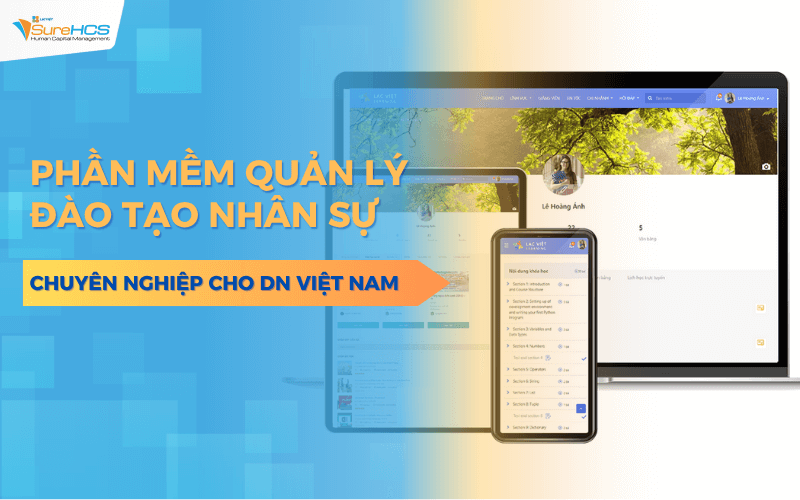
In strategic human resource development, modern internal training not only is the tool enhance the skills but also the core elements help business build your team have the capacity to adapt quickly to change. Software lacviet E-Learning is designed to meet the fulness of the demand, it brings a training system online comprehensive smart, easy to operate for every business.
Below is the training features highlights of the software training staff Vietnam E-Learning, along with the actual value that the business receives when deploying this system:
The system enables enterprises to build, deploy, manage multiple training program different only on a single platform.
- Business can design internal courses (videos, slides, documents, quizz...) or import course from outside.
- Support hierarchical management training according to the department, title, or capacity.
- Allow to set the route of training for each employee or group specific audience.
Learning anytime, anywhere on any device: Vietnam E-Learning support, online learning, multi-platform (web, mobile, tablet) help employees actively learning anywhere, at any time.
- Integrated mobile application with friendly interface, easy to use.
- Lets download lessons to study offline, track progress automatically when the network is back.
Staff members can learn to the beat of its own to help increase the autonomy, the efficiency of the collection. Especially suitable for business has a team of dispersion, affiliates or employees working remotely.
Evaluation check after automatic training: integrated System of the test format as diverse as multiple choice, essay, simulation, situation, or practice.
- Automatic scoring and statistics results, students determine the degree of completion of the course.
- Provide analytical reports training effect in real-time: attendance rates, grade point average capacity improved after the course...
LAC VIET E-LEARNING – SOLUTIONS, PERSONNEL TRAINING, INTERNAL BUSINESS PERFORMANCE MEASUREMENT
Lac Viet E-learning is the trusted choice of many large corporations such as FrieslandCampina, PV GAS, Shinhan Bank... with more than 100,000 users across the system.
LV E-Learning is not just a training system online, which is the platform that helps businesses build human capacity in a sustainable way. The solution is designed to solve the fulness of the problem: training – measurement – develop – retain talent in the work environment is great.
- Difference of LV E-Learning lies in the ability to combine flexibility between technology, learning experience and management training. Businesses can deploy according to the SaaS model or on-premise, easy to integrate with existing systems
- In compliance with the international standards such as SCORM, OpenBadges, ensuring standardized and scalable long term.
- Don't stop at the “bringing material up system,” LV E-Learning create learning environments multimodal: online class, learning materials, multimedia, forum for exchange of knowledge, exam – assessment – certificate automatically.
- The entire learning process of the employees are tracking, analysis, reporting in real time, to help businesses accurately assess the effectiveness of training and the level of capacity development.
- Modern interface, high security, automation, deep, ability to analyze training data to help businesses optimize the cost of training, improve work productivity, increase employee engagement.
SEE DETAILS MANAGEMENT FEATURES TRAINING LV E-LEARNING AT HERE
Ready to elevate effective internal training in your business?  Contact us Lac Viet today for advice model implementing E-Learning in accordance with the scale, industry and development goals of the business.
With version Cloud, LV E-learning can deploy fast in 7 daysno need to invest in infrastructure, high security and are willing to expand to tens of thousands of users.
SIGN UP TO RECEIVE DEMO NOW
CONTACT INFORMATION:
- Hotline: 0901 555 063
- Email: [email protected] | Website: https://www.surehcs.com/
- Office address: 23 Nguyen Thi Huynh, Phu Nhuan, ho chi minh CITY.CITY
With management systems, comprehensive training – effective measurement associated capacity rating, Vietnam E-Learning helps the organizations and enterprises are to find out information about the criteria for evaluating employee year end easy to deploy development strategy, human resources, it saves sustainable. Discover more at: https://elearning.lacviet.vn/