




end of the year is the time of the business conducted summative assessment work efficiency of staff — a process important to help determine the level of completion of goal orientation, training and building remuneration policy fit for the next year. However, writing rubric staff end of the year stars for objective, professional, bring actual value, not the organization would also perform properly.
A rubric staff last year was built, a standard not only help managers perceived the exact capacity, work performance of the individual, but also the tools, motivation, mounted employees, optimize the performance of human resources.
This article Lac Viet SureHCS will guide in detail how to writing rubric staff end of year standards, accompanied evaluation form staff last year to business can refer to flexibly apply for each department, work location.
1. Rubric staff last year is what?
Rubric staff last year's form (form form) is used to synthesize the recorded results, work capacity, attitude, potential, development of employees throughout a year of work. This is an important document to help managers:
- Track progress and quality of work of each individual.
- Take out review qualitative, quantitative, based on criteria specific reviews.
- As a basis for the decision hr strategies (reward – and-punishment – training – progression).
A form template employee evaluation end of year typically consists of the main part:
- Employee information (name, title, department).
- Objectives, KPI registered early years.
- Results of work performed (according to quantitative and qualitative).
- Rated capacity, behavior, work.
- Review proposals of the management directly.
- Development plan or goals for the coming year.
Other than the form periodic review (month/quarter), the end of the year brings the total cases, the long-term development direction, often used in the organizations and enterprises are seeking information about how to writing rubric staff last year to standardize hr processes.
The construction and use correct form employee evaluation last year to help businesses:
- To ensure fairness, consistency between departments.
- Minimize conflicts in the process of review bonus.
- Improve the quality of data reporting service personnel from that help managers make decisions more accurate about human resource strategy.
In general, a rubric staff last year was written the right way not only reflect the results of work that was “broken mirror” to help both employees and enterprises grow together.
2. Why business need reviews staff last year?
Reviews staff end of the year not just activity summarizing but also a strategic tool that helps business performance management and development of human resources in a sustainable way.
Specific businesses need to deploy rubric staff last year because of the following reasons:
- Overall the performance, the result work of staff: Through the recognition results than the target (KPI), managers easily evaluate the level complete the mission of each individual and department. Since then, business has more comprehensive overview about the performance of the year.
- As a basis for personnel decisions important: the evaluation is objective basis to review year-end bonus, salary increase, promotion, or training plan. The evaluation is based on data help limit feelings, increase fairness and transparency in the system administration personnel.
- Enhance cohesion, motivation of staff: as reported By Deloitte in the year 2023, the business has a policy feedback, reviews clear to help reduce 31% rate of voluntary leave, because employees feel their efforts are recognized and orientation clear development (Source: Deloitte Human Capital Trends 2023).
- Support development planning human resources: When synthetic data from the evaluation staff last year, the hr department can identify those individuals potential for location, design, planning appropriate training.
Thus, the rubric is not only a form that is tool management strategy to help businesses balance between business efficiency and human development – two important pillars in human resource management modern.
3. The criteria for evaluating employees last year in the popular business
In most organizations, the evaluation staff year-end is designed based on four groups criteria for evaluating employees last year main: job performance, professional competence, work attitude, and development potential. Each criterion not only help businesses measure the effectiveness of work which is also grounded to plan roadmap career, personnel policy, the long-term.
Below is the criteria for evaluating the most popular now:
3.1. Criteria of job performance (Performance)
This is the core criteria in any form sample employee evaluation last year. The goal is to measure the level of completion of the work than planned or Key Performance Indicators (KPIS) have been delivered beginning of the year.
A number of factors are usually considered:
- Work results: employees have completed on schedule, achieving goals is not.
- Quality of work: product or service by the staff created are standard quality does not.
- Work efficiency: the ability to optimize resources, cost savings, or contribute outstanding value to the team.
For example: An employee business KPI revenue 1 billion/year. If the result reaches 1.2 billion, the complete is 120% – a rating of “Exceeds expectations”.
Actual value: performance reviews help businesses clearly define who is creating the highest value, from which it can reward policy – remuneration reasonable. At the same time, this is the basis to detect the location need more training or layout to suit.
3.2. Criteria of competence (Competency)
This criterion is assessed ability to perform the work of employees, including:
- Professional competence: knowledge, professional skills meet the job requirements.
- Soft skills: communication, team work, problem handling, critical thinking.
- The ability to adapt learning: willing to update technology, new process.
According to research by LinkedIn Learning Report 2024, 89% of business for that capacity to learn in constant development (learning agility) is the top element helps employees to sustain and advance in the changing environment quickly (Source: LinkedIn Learning Report 2024).
Actual value: The capacity assessment to help businesses identify “the competency gaps” between the job requirements and existing capabilities of employees. Based on that, businesses can build a training plan suitable contribute to improving the quality of the team.
3.3. Criteria of attitude behavior (Behavior & Attitude)
Work attitude is the factor expressing the corporate culture and internal mount. A staff expertise but lack cooperative spirit or discipline can negatively affect the body.
The elements commonly rating:
- A sense of responsibility in work.
- The level of proactive, willing to support colleagues.
- The style, the attitude when communicating internally or with customers.
- Compliance with rules, workflow.
For example: An employee is frequently late, don't report the progress of the work will be underestimated about attitude, whether KPI can still achieve.
Actual value: assess the attitude to help businesses maintain the work environment positive, decrease conflict, and build a collaborative culture. This is also an important criteria when considering rewarded or promoted to management positions, because leadership is always associated with attitude, professional work.
3.4. Criteria of development potential (Potential)
Besides, the current results, businesses need to evaluate the possibility of future development of employees, also known as leadership potential, learn.
The factors to be considered include:
- The ability to receive information processing fast.
- Creative thinking problem solving complex.
- Ability to lead a team to a positive influence on others.
- Level ready to take on the role higher.
Actual value: assessing the potential to help businesses, team building, design approach, to ensure continuity in management and organizational development. With rubric staff last year, this is the important part of helping managers proposed roadmap for career fit, avoid “brain drain”.
4. How to write evaluation staff last year – step by step instructions
The construction of the evaluation staff last year did not just stop in the total the work efficiency, but also as a tool to help business human resources management, efficient decisions about training, promotion or remuneration based on transparent data.
Here are detailed instructions how to write, is suitable for the organizations and enterprises are seeking information about how to writing rubric staff last year.
Step 1. Identified target of evaluation
Before embarking on designing form templates, business should clearly identify the target of evaluation: aims to reward review salary increase planning a successor or evaluation capacity development. The objectives help managers choose the matching criteria to avoid evaluation form.
For example, if the goal is “training and development”, the evaluation should focus on capacity to act, soft skills, instead of just the number of KPI quantitative.
Step 2. Building structure rubric
A form template employee evaluation end of year standard should include 7 main sections:
- Employee information (name, position, department)
- The objective or KPI years
- Results of implementation and demonstration
- Rated capacity, work attitude
- Synthetic score rating
- Review of the management directly
- Development plan for the next year
This structure helps the business to ensure the full, easy to follow and compare the results between the employees.
Step 3. Set point scale, dot method
Scale popular usually in the form of 1 to 5 or from 1 to 100, depending on the scale and the organizational culture. Businesses can apply:
- Reviews 1-dimensional (evaluation management staff)
- 360 degree assessment (collect from superiors, peers, subordinates).
According to research by Gartner, evaluation form, 360 degree help to reduce 14% of the risk of bias in personnel evaluation and improvement of 22%, the accuracy of the results (Source: Gartner 2024).
The company is now often software application hr manager to automatically aggregate points, on average, reduce errors, save administrative time.
Step 4. Write a review, detailed oriented development
The comments section is content present value of the evaluation process. Managers should write a review-specific, honest, avoid the generic sentence like “complete the work”.
For example:
- Strengths: “Complete 120% of the planned sales, proactive support team to reach KPI.”
- Points to improve: “Need advanced skill to manage time to avoid late-term project.”
Finally, the conclusion should be attached to the development plan as proposed training, adjust the KPI or see the review rewards and progression. When done properly, process evaluation staff last year not only the end but also the tools to promote performance, mount the employees with overall objectives of the business.
5. Sample rubric employees at year end (free Download)
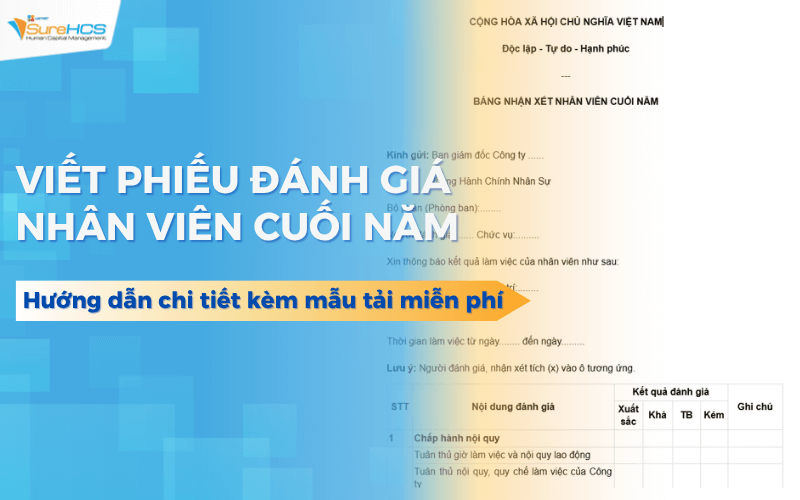
A sample rubric staff last year was built, a standard not only help the evaluation process becomes transparent, easy to implement, but also is the basis for business decisions, hr fair from salary increase, bonus to training and planning officers successor.
This form is suitable for medium scale business and organizational structure, many managers, the need to ensure consistency in rating between departments. Business can customize the flexible criteria to fit particular industry or rank employees.
A form template employee evaluation end of year usually consists of 4 main criteria:
- Work results (KPI/OKR): performance measurement, complete level objectives for the year.
- Professional capacity: assess vocational skills, ability to solve problems, creative work.
- Behavior, attitude to work: consider the spirit of cooperation, discipline, attitude with customers and colleagues.
- The goal of personal development: the planning, career development, commitment with the business.
To support the organizations and enterprises are seeking information about how to writing rubric staff last year, Vietnam has pre-designed sample rubric staff end of year format in Excel and Word, easy to edit, suitable with many scale organization. Template included full:
- Board evaluation criteria according to 4 groups capacity;
- Column points self-assessment, management points, grade point average;
- The detailed review of direct management;
- Suggestions plan personal development for the following year.
6. Solution Lac E-Learning, online training, comprehensive for the enterprise
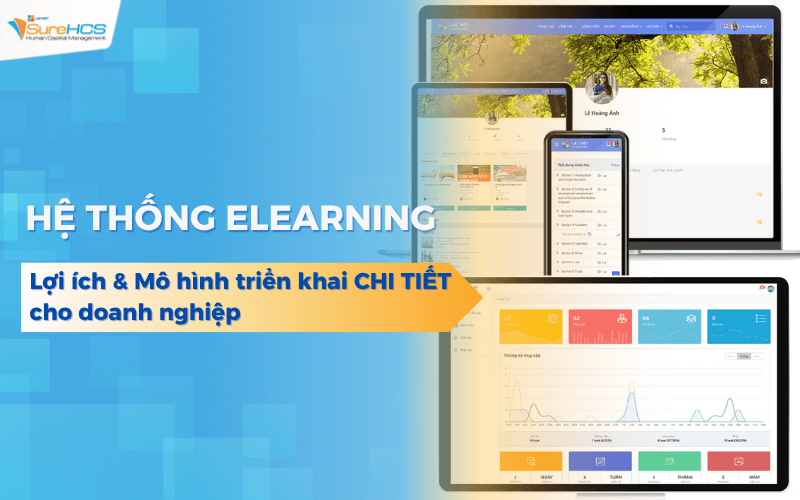
In the context of transformation of the ongoing strong business cannot be based only on the form of traditional training — time-consuming, high administrative costs, difficult to monitor effectively. This is, at Vietnam E-Learning become training solutions comprehensive online support, business building system of internal efficiency, flexibility.
Vietnam E-Learning is foundation online training elearning developed by The company Lạc Việt, with the ability to compose a lecture, course management and assessment of progress of learning in an automatic way. This platform integrates the standards such as SCORM, Tin Can, support virtual class (virtual classroom) allows businesses to customize content according to the peculiarities each department or each position.
The salient features bring the real value for the business, including:
- Student management & training progress clear: managers can track the learning status of each employee, know who is complete, who is missing.
- Assessment, certification automatically: After the course, the software automatically grade homework, stored results, the certificate if it meets the criteria output.
- Flexible forms of learning & cross-platform access: Employees can follow the schedule or freedom, access on pc, tablet, mobile suit many forms of work.
- Integrated data analysis report: the platform supports export of reports according to many indicators (the number of learners, schedule, scores...) to HR departments to compare strategic decisions.
LẠC VIỆT E-LEARNING – GIẢI PHÁP ĐÀO TẠO NHÂN SỰ NỘI BỘ DOANH NGHIỆP ĐO LƯỜNG HIỆU QUẢ
Vietnam E-learning là lựa chọn tin cậy của nhiều tập đoàn lớn như FrieslandCampina, PV GAS, Shinhan Bank… với hơn 100.000 người dùng trên toàn hệ thống.
Lạc Việt E-Learning không chỉ là một hệ thống đào tạo trực tuyến, mà là nền tảng giúp doanh nghiệp xây dựng năng lực con người một cách bền vững. Giải pháp được thiết kế để giải quyết trọn vẹn bài toán: đào tạo – đo lường – phát triển – giữ chân nhân tài trong môi trường làm việc hiện đại.
- Điểm khác biệt của Lạc Việt E-Learning nằm ở khả năng kết hợp linh hoạt giữa công nghệ, trải nghiệm học tập và quản trị đào tạo. Doanh nghiệp có thể triển khai theo mô hình SaaS hoặc on-premise, dễ dàng tích hợp với các hệ thống hiện có
- Tuân thủ các chuẩn quốc tế như SCORM, OpenBadges, đảm bảo tính chuẩn hóa và khả năng mở rộng lâu dài.
- Không dừng ở việc “đưa tài liệu lên hệ thống”, Lạc Việt E-Learning tạo ra môi trường học tập đa phương thức: lớp học online, học liệu đa phương tiện, diễn đàn – wiki trao đổi kiến thức, thi – đánh giá – cấp chứng chỉ tự động.
- Toàn bộ quá trình học tập của nhân viên được theo dõi, phân tích báo cáo theo thời gian thực, giúp doanh nghiệp đánh giá chính xác hiệu quả đào tạo và mức độ phát triển năng lực.
- Giao diện hiện đại, bảo mật cao, tự động hóa sâu, khả năng phân tích dữ liệu đào tạo giúp doanh nghiệp tối ưu chi phí đào tạo, nâng cao năng suất làm việc, gia tăng sự gắn kết của nhân viên.
XEM CHI TIẾT TÍNH NĂNG QUẢN LÝ ĐÀO TẠO LẠC VIỆT E-LEARNING TẠI ĐÂY
Sẵn sàng nâng tầm hiệu quả đào tạo nội bộ trong doanh nghiệp của bạn?  Liên hệ Lạc Việt ngay hôm nay để được tư vấn mô hình triển khai E-Learning phù hợp với quy mô, ngành nghề và mục tiêu phát triển của doanh nghiệp.
Với phiên bản Cloud, Lạc Việt E-learning có thể triển khai nhanh trong 7 ngày, không cần đầu tư hạ tầng, bảo mật cao và sẵn sàng mở rộng cho hàng chục nghìn người dùng.
SIGN UP TO RECEIVE DEMO NOW
CONTACT INFORMATION:
- Hotline: 0901 555 063
- Email: [email protected] | Website: https://www.surehcs.com/
- Office address: 23 Nguyen Thi Huynh, Phu Nhuan, ho chi minh CITY.CITY
Deployment Vietnam E-Learning help close connection between training and performance evaluation of staff. Staff are equipped with knowledge, skills, longer leaders have the data to judge based on real results from which reduce the subjective, increase transparency in hr process.
When building stock or sample employee evaluation last year, the business should not see this as administrative activities merely, but should consider it as a significant step in performance management overall. A system of comprehensive evaluation, equity-oriented development that will help the business optimize productivity, retain talent, creating work culture positive.



![Mẫu đánh giá thử việc chuẩn nhất 2025 [Tải miễn phí, dễ tùy chỉnh]](https://www.surehcs.com/wp-content/uploads/2025/07/mau-danh-gia-thu-viec-chuyen-nghiep.png)